Česky
Česky


When everything works like clockwork, few people actually notice the IT infrastructure and services within the AKESO holding hospitals. This is despite the fact that they have a modern call system panel right in front of their eyes, which of course falls into the category of IT solutions. The patient does not think about the fact that behind such a solution there is a lot of work and a whole bunch of people.
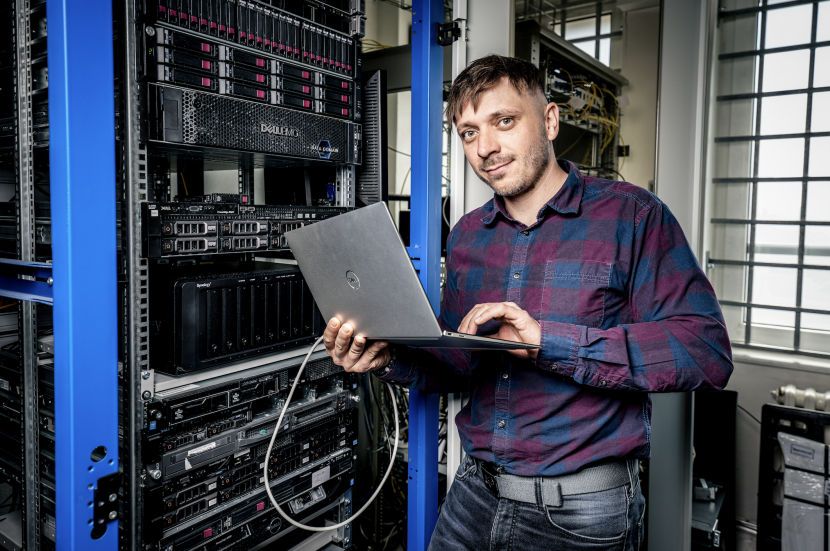
And why should he. Information technology accompanies us at every step today, so it is logical that it is commonplace even in the hospital environment. However, it is in this environment that information technology plays perhaps an even more important role than elsewhere - in fact, it looks after the health of patients themselves. "Outages are a nightmare for us, so our main task is to prevent them," says Jan Dobrý, head of the operations department of the IT holding AKESO, which manages IT operations.
What does operational IT actually entail in a hospital environment?
Basically it is the same as in other environments, it is a very broad field. Basically, we take care of everything from a paper jam in the printer in the surgery to the renewal of the hospital's IT equipment to the entire IT infrastructure, including servers. We deploy and maintain systems and applications developed by our development department in Beroun or supplied by external suppliers. Of course, we also work on the design of IT infrastructure, on the occupation of new buildings, etc. It is important to remember that in this respect, IT is an absolutely critical part of running hospitals. As digitalisation progresses in virtually all areas, the role of IT in the hospital environment is becoming increasingly important. And potential outages are a nightmare.
What complications can such an outage bring?
It depends, of course, on where it occurs, what it knocks out. When one computer in the surgery breaks down, it delays several patients, but it's nothing serious. But an outage somewhere in our infrastructure would essentially cripple the entire hospital and could endanger the health of patients. This is where hospital IT differs fundamentally from other areas where, in the event of an outage, it is all about money. But here, it's about people's health. That's why, as with patients, prevention is important in hospital IT.
What does such prevention look like?
Basically, we're constantly replacing older equipment and solutions with new ones, it's kind of a cycle. We're always testing something to see if it works as it should. We don't just wait for an outage, even a small one, to happen, we try to solve everything in advance. We're constantly going through different scenarios of what could happen, whether we have spare parts for certain equipment, whether we need to have spare network infrastructure elements, and so on. As far as IT infrastructure is concerned, the use of back-up power supplies and, of course, diesel generators to ensure the supply of electricity in the event of an interruption from the grid is a given. And we will be greatly helped by the upcoming data centre, which will provide a more robust foundation for all our IT.
Is the ongoing chip and supply chain crisis affecting your operations in any way?
Yes, we are definitely feeling these complications. But we have to deal with them. We certainly can't wait for spare parts for one of our servers to arrive. We need to deal with the situation immediately. In many cases, we have had to pre-stock or devise alternatives that allow us to react flexibly. Our traffic never stops, nor must it ever stop.
"The role of IT is increasingly important in the hospital environment."
What else are you working on now besides prevention and ensuring IT is running reliably?
In addition to this essentially critical day-to-day running, we are of course dealing with future development. Right now, for example, we are working on a crisis information centre system that will collect all reports of events and outages throughout the hospital in one central location and immediately inform the relevant staff: the technical department, us, and so on. We will have a kind of command centre in the reception area where everything can be monitored and where it can be seen whether the problem has been taken over for resolution. The staff will have certain scenarios for dealing with specific situations.
We are also going to be fitting new buildings with IT technology. We are talking about the new building in Hořovice, which we call the hospital of the new millennium, and also the building of the Mental Rehabilitation Centre in Beroun. These will be places with modern equipment and IT features that patients may not have seen in a hospital setting before.
Last but not least, we are also looking at some development, whether it is directly about our skills or some overlapping further afield. The hospital management supports us in this, and as a result we are working in the area of 3D printing, for example. Colleagues have supported the medical operation during the ongoing pandemic by supplying small parts or parts printed on 3D printers. This was to make up for shortages of parts that were not available at the time. Not only the interest, but also the circumstances led us to build our own printers within the IT department in addition to the existing ones and we are ready to help again at any time. In the meantime, we use the printers to print various holders, cases and other accessories for systems or assemblies that are tailor-made for our operations.
What do you print on them?
Often, of course, these are experiments that serve to develop the knowledge of our technicians. But the printers also have a practical purpose. At the time of the covid-19 pandemic, for example, we printed a kind of headband for face shields, and we printed various reducers and adapters, including, for example, reducers that could be used to attach filters to a conventional diving mask during the covid era. We print various holders, for example for test tubes, and so on. Operationally, we can handle a lot of small things.
"We used 3D printers to print headbands for face shields in the pandemic."
Luděk Vokáč, photo: Jan Vlček