Česky
Česky


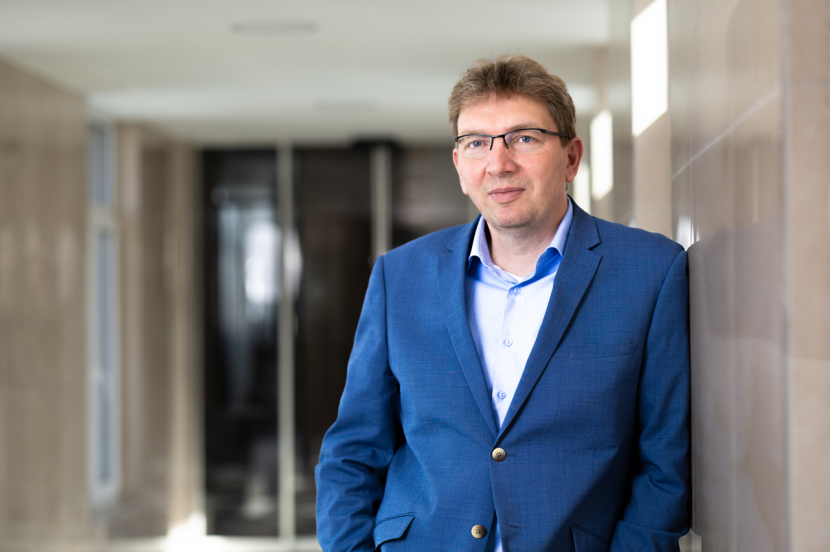
Mr. Director, at the beginning of this year you took over the management of Hospital Hořovice. How were the first weeks? Did you get the proverbial 100 days of advocacy?
The hospital is an operation that runs 24 hours a day, 7 days a week and 365 days a year, so all changes happen on the fly. There are some seasonal fluctuations, but otherwise there is not much opportunity to take a breather, to take a break, to get comfortable. So no, I haven't had 100 days (smiles). I came into the job from the position of deputy for curative and preventive care. So I was not a newcomer. But the first weeks were definitely more challenging. Taking over the management of the hospital in Hořovice from my predecessor , MUDr. Michal Průša, is still ongoing. Hospitals are like very sophisticated organisms that must constantly evolve. They cannot stand still, otherwise they will stunt or, in the worst case, disappear. This is not our case. Our hospitals are constantly evolving. Its buildings have been renovated, equipped with state-of-the-art technology. We have qualified specialists in our teams and are continuously recruiting more. As the construction of the new pavilion continues, we will see more development and with it more changes and challenges.
What are your plans and priorities for the coming months and years? Will you build on the work of your predecessor?
I thank Director Průš for his years of dedicated work for our hospital. During his tenure, extensive reconstruction was completed, and the number of operating theatres was increased from three to six. The number of surgeries grew every year, and a brand new and fully equipped kindergarten was built for the children of our employees. We built a new car park for patients, a new pavilion for the children's intensive care unit and construction of a new pavilion - the Next Generation Hospital - was started. We have known the director for a long time. Specifically, since he was the Chief of the A&E department at one of his previous posts and I joined him as a novice anaesthetist. Then our paths diverged and after many years we met again, this time in Hořovice. Our cooperation still continues. Michal Průša continues to work at ARO as a doctor, expert advisor and mentor. He is intensively involved in the field of algesiology (pain treatment).
So the construction of the new pavilion continues...
Yes. It is progressing more slowly, but we are already working out the timeframe and sequence for commissioning the new building. It will be gradual, in stages. We will probably open the central sterilisation unit, the radiology department, other operating theatres, the inpatient orthopaedics department and the central reception first. For central sterilisation and X-ray, it will largely be an extension of the existing premises. This is due to the way in which the existing and new buildings are related to each other. Sterilisation is key for us. Because once we have the operating theatres in the new pavilion up and running, we need to have increased capacity in central sterilisation. We have to prepare for the fact that we will be moving entire wards during normal hospital operations. We will also gradually recruit dozens, or rather hundreds, of new employees. We will need additional flats for them and a larger nursery, both of which must be operational before the new pavilion.
When will construction of the additional flats and the new nursery pavilion start?
Very soon. We have the site for the new nursery selected and ready. And so is the project. We are already working on the building permit. The second nursery pavilion will be similar to the existing one. It will have a circular plan and will be one storey high. It will house two classrooms for more than 40 children. It will also be accessible from the street. Parents will then stop nearby, drop off or pick up their child and leave. We also already have a project in the pipeline for more new apartments. There should be about 80 of them initially in several apartment buildings to be built in the area from the already built apartment buildings towards the employee parking lot. We want to start construction preferably already this year. One of the other projects is a children's operating theatre.
Where should the children's operating theatre be built?
In the space between the children's ward and the NICU (intensive care unit for children). Its construction is also due to start this year, while the administrative issues of the construction are still being sorted out. The room will be used for procedures on children who do not require long-term hospitalisation. For example, in operations on nasopharyngeal tonsils (adenotomies), and also for classical paediatric surgery - such as various paediatric hernias and the like. Our aim is to perform these procedures in a sufficiently high volume and at the same time with high quality. This is the only way to make Hospital Hořovice interesting for patients from more distant regions. When we say that we do some procedures the most in the country, it means that we know how to do them and we do them well. Parents from Karviná (exaggeration) will have a good reason to take a car and come to Hořovice, leave their child with us, have, for example, nasopharyngeal tonsils removed, and return home the next day. Of course, I don't expect anyone from Karviná to come to Hořovice with stomach pains or to have their appendix operated on here. That's just acute care. But for planned, i.e. non-acute procedures, it is possible, because the patient has time to choose where to have the operation.
Will healthcare in the Czech Republic become more affordable in the coming years?
The availability of healthcare in the Czech Republic will rather deteriorate in the coming years. People from the Karlovy Vary Region could already tell us. At the same time, however, transport services are improving, although we may not think so when standing in a traffic jam on the D5. So, if we offer quality care, information, standard patient access, then this is what will ultimately decide between successful healthcare facilities and those that fail. There will be a selection of workplaces, as there already is, for example, with maternity hospitals. And we want to be successful. We want Hospital Hořovice to continue to function, to grow and to provide a significant volume of quality care, exceeding the region in both quantity and quality.
What other advantages do we have?
Our huge advantage is the large capacity parking for patients. Many teaching and regional hospitals struggle with a lack of parking. You can drive to them without too much trouble, but you're circling around for the next half hour before you can park. With us, you'll be parked in no time. Once the Hořovice bypass is completed, which is beginning to emerge overlooking our hospital, we will also have better connections to the D5 motorway. The commute will be faster and more comfortable for patients and employees. They will no longer have to zigzag through serpentine roads and through several bottlenecks. This can also be a decisive factor in favour of Hospital Hořovice when people decide whether to come to us or to a competitor.
Which of the projects will be the most important?
They are all important. A very crucial investment and change that awaits us in the next year, maybe 18 months, is the upgrade of our hospital's information system. This is an action that is not visible from the outside. But the information system is essential to the running of the hospital and, if everything goes to plan, a more powerful version of it will take us significantly forward. Another important project is the new central laboratory building, which should be built behind the existing ones. Preparations are also culminating for robotic operations, which we will begin to carry out in late summer/early autumn. Their launch will be preceded not only by the installation of a state-of-the-art robotic system, but also by the training of our operating teams. At the same time, smaller, less visible projects are underway, which are not directly part of the medical processes, but are absolutely essential for the hospital's operation. These include the construction and relocation of the energy centre or the planned construction of a waste management building.
How would you introduce Hospital Hořovice to someone who does not know it yet?
We are a relatively atypical healthcare facility in the Czech Republic. We are a purely private general hospital and there are not many of those in our country. Private hospitals and clinics are much more often specialised. But we provide the whole spectrum of care and we cooperate with all health insurance companies. Our care is covered by public health insurance. If a patient comes to us, he or she receives quality care paid for by the insurance company. We are no longer a district hospital. We are comparable to some county hospitals. We are a relatively large hospital with 1 200 employees in a town of 6 800 inhabitants.
We're also one of the largest employers in the region...
Yes, and we benefit from our proximity to the D5 motorway and therefore our relative proximity to Prague and Pilsen, from where many of our employees commute. At the same time, this means a lot of competition for us. This concerns both the staff and the patients who choose whether to have their operations performed here or, for example, in Motol in Prague. That is why our business model is based on the fact that we provide such high quality care that it is worthwhile for patients to come to us even from a longer distance.
It's also worth it for the employees...
That's both a big task and a tall order. There is a wide range of jobs in the health sector in the Czech Republic. Especially in the Central Bohemian Region, the proximity to Prague plays a significant role. Other hospitals in the "ring" around the capital, i.e. in the Central Bohemian Region, also face this situation. In this respect, mobility and transport accessibility is double-edged - it is as easy to commute from Prague to Hořovice as vice versa, although it is more difficult. We must therefore strive to create working conditions that make it worthwhile for our employees to stay. There is a lot of competition - especially from facilities that also receive income from regional and other public budgets. We have to earn our own way of operating.
We are aware that the issue of wages is very important to many of our employees and that they have been asking for wage adjustments for some time. We take this dialogue very seriously. At the same time, we know that other factors also affect job satisfaction. That's why we have long strived to build an environment where work is meaningful - whether it's in terms of training support, team atmosphere or specific benefits. We are now developing affordable housing in additional fully equipped apartments that can significantly help both our current and future colleagues. At the same time, we continue to improve benefits such as transport, pension contributions, fuel cards and discounted mobile operator tariffs.
Hospital Hořovice is already a household name in the Czech healthcare sector...
Yes, we have an excellent maternity hospital with a high number of births and an excellent orthopaedics department that performs approximately 1,500 joint replacements a year. We have a unique post-acute intensive care unit for children, a bariatric centre with a supra-regional reach, a dynamically developing urology department - and a robotic operating theatre coming soon. We also have other specialist workplaces and facilities that contribute to the reputation of Hospital Hořovice with their quality work. Our task is to develop the hospital organically so that it brings quality care and benefits to patients and clients. At the same time, we want the work there to make sense and bring satisfaction to its employees. My goal is to achieve a state where our people themselves say to their colleagues, classmates and friends, "Come work with us, it's nice here."