Česky
Česky


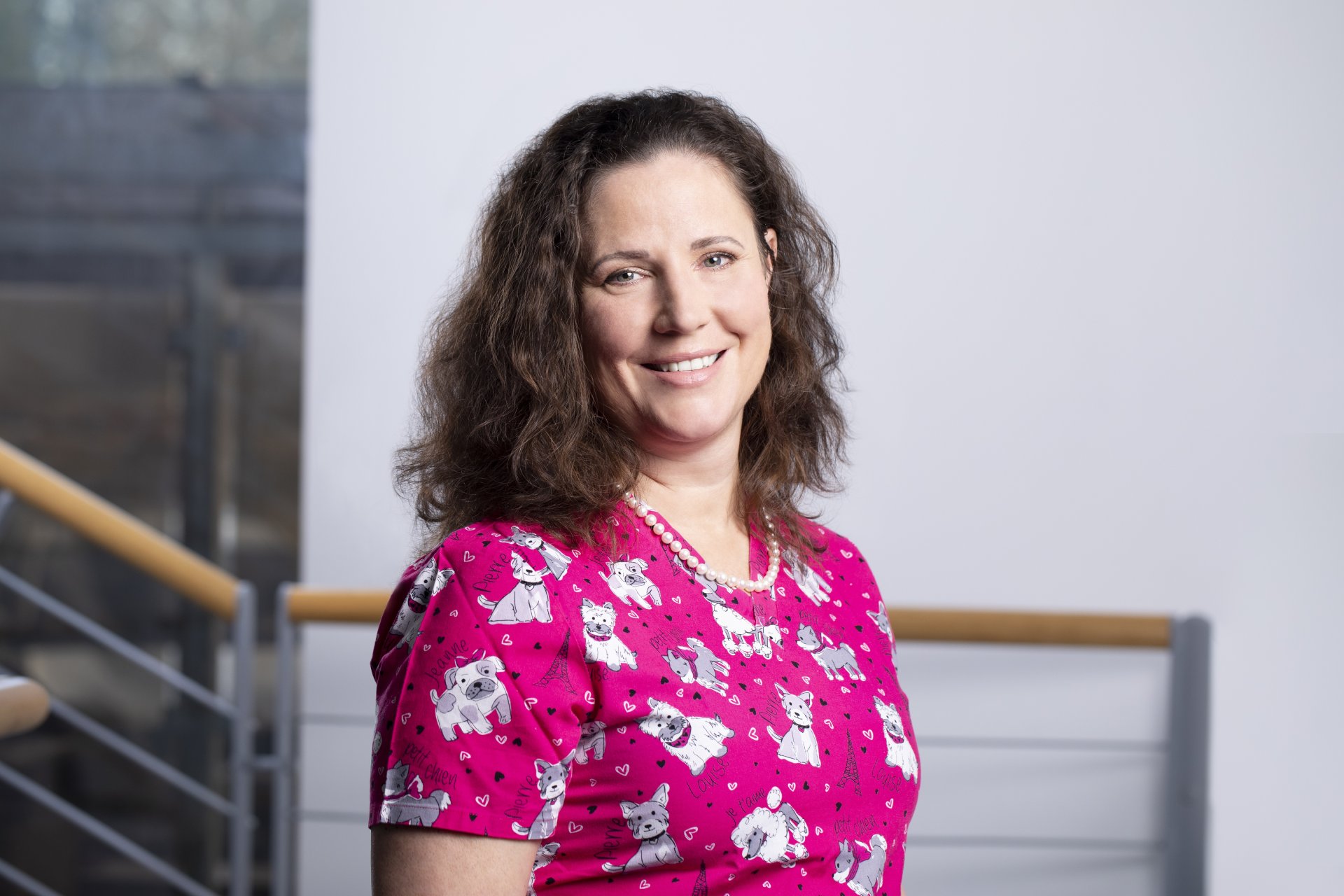
As head of the children's ward at the hospital in Hořovice, Mahulena Exnerová helps young patients to recover. In another role, she also helps those who have no chance of recovery... The experienced doctor is also the head of the children's palliative care section.
Do you hear reactions like, "Oh my God, what have you got yourself into?
I get that from both lay people and colleagues. The reactions are usually a mixture of wonder and admiration, and I resist admiration because I feel that I am simply doing something that is needed. I usually hear questions along the lines of: How can you do that? How can you stand it? I see behind those questions the fear that children's palliative care evokes in people. In their eyes, it is such a difficult subject that they want nothing to do with it.
Why do you?
To me, it's medicine like any other. We cannot turn a blind eye to the fact that there are diseases that we cannot cure and that these diseases affect children. I think it makes a lot of sense to look at what we can offer such patients. For many people, of course, their own fears play a role: the projection that something like this could happen to them is very difficult for them.
I understand that completely.
Of course, I do too. As a parent, I don't want to imagine anything like that either, I just don't! Nevertheless, I think I can help those who have to face these very difficult things. And above all, I am convinced that help is very much needed in these cases.
Help consisting of facilitating a passing, not a recovery - isn't that depressing about palliative care anymore?
We are faced with illnesses that are serious and in some ways limit the length of survival. But if we're talking about children with a cancer diagnosis, for example, eighty percent are cured. Nevertheless, it is very important that the parents of these children are also heard at the outset: We will do everything we can, but even so, it may not turn out well. You can count on us to be there for you in every situation.
Denial, anger, bargaining, depression, reconciliation - these are the classic phases that terminally ill people go through. Parents of seriously ill children too?
Yes, and these phases can be intertwined, they can return, there is not necessarily reconciliation... It is good to know this and to try to find out what phase we are in. Sometimes the child himself is our communication partner. Of course, age and mental capacity have to be taken into account, but even a five-year-old can understand, for example, that a sibling is dying. Even if it is the case that he goes to play immediately after you tell him the news, that is perfectly normal at his age. We use less common and more varied means to communicate with children than with adult patients, for example, toys or drawing materials are helpful. But just like an adult, a child needs to talk about the illness.
What if this is not what the parents want?
Sometimes we hear it from them. Okay, we answer, we respect your wishes not to be proactive, but if the child asks us, we won't lie to them. Because once he finds out you're not being straight with him, he won't forgive you, the trust is gone once and for all. We sometimes approach parents with a kind of offer: If you're afraid to talk about it, can we do it for you? Because if a child doesn't ask, it doesn't mean he doesn't want to hear the truth.
So why doesn't he ask?
Quite often we find that the illness is not talked about in families and parents beg us: just don't tell him! But the child still feels that his illness is serious, and maybe even that it is coming to an end. He doesn't ask just because he is protecting his parents, because he doesn't want his mother to cry. Perhaps the greatest service we can provide is just opening up communication so that nothing is left under wraps. Because if the child doesn't find out the truth from us, then you bet they'll find out the truth elsewhere and perhaps inappropriately in this day and age of social media.
At what age is a child capable of understanding their own poor perspective?
If you're asking about understanding the irreversibility and finality of death, then from about age seven or eight. Illness moves children forward in their thinking, and in this sense they are considerably more mature than their healthy peers.
I don't even want to ask the question, yet: do children ask directly about their own death?
They will ask, and then they need to find out exactly what they are interested in. An eight-year-old doesn't ask about the philosophical and ethical implications of death, but about completely practical things like: What happens to my body? Or, when his mother dies, he asks, in fairness, what about the worms in the ground. Anyway, the question "Am I going to die?" can't be answered with the phrase "We're all gonna die."
So how to answer?
Well, with a counter-question, which is not to be evasive. For example, "Honzik, why do you ask? Are you afraid of something? How many times do we really find a child's fear that he will suffocate, that it will hurt him, that his mother won't be with him... Adolescents, on the other hand, perhaps want to prepare for leaving, want their classmates to come, want this and that to happen. One girl wanted no one to come to her farewell party in black, but in pink, and everyone did come in pink. I get goosebumps talking about it, but it's terribly important to give a child competence, choice, control over the situation.
And if the child doesn't ask what happens to his body, but what happens after death?
That's a terribly personal question, and one has to come clean with the truth. To say: This is what I think, this is what you think? Look, Johnny, I think we're going to meet our loved ones...
Excuse me - are you giving an example now, or are you actually speaking for yourself?
Personally, I really feel that way. I believe that death is not the end of everything, this is my hope that helps me, and I hope it will help me in my own passing one day. But of course I can't say anything for sure. In this question, it always depends on the maturity and setting of the particular person, the tradition in which he or she grew up, also, for example, whether the family is anchored in faith, by which I don't mean to say that the situation is easier for a believing family, not at all.
But faith can be supportive, can't it?
I think in a way, yes. And be warned, spiritual support does not automatically mean the care of a pastor, as is often perceived from the outside and people get scared senseless. Once we get into liminal situations, we simply cannot do without support. We very much need the reassurance that it does not end with death. This hope is sorely needed and faith can provide it. And there is also a more prosaic dimension: in my opinion, unlike in other countries, belonging does not work very well in the Czech Republic. We are very individualistic, yet the community - which certainly does not have to be made up of the church, but is partly made up of it - is able to help in difficult moments. And even in quite practical things, like someone to cook for a person, to do the shopping, to look after the child... I think it's a great pity that there is not much of this in the Czech Republic. But I must stress again: it is certainly not the case that a believing family would say "God gave, God took away" in reconciliation over the loss of a child.
Call me out if I am being unduly intimate, but you yourself ask why God, if He exists, allows the suffering and death of children?
I don't have an answer. I take it as a fact that it is so, that there are situations in which I cannot see their meaning, cannot discern their meaning. A good answer certainly doesn't sound like in ten years one might understand in hindsight what it was all for, though the truth is that suffering can make a person stronger. There may be some sense in that, but would I say with a clear conscience that the Lord has it well figured out? I really don't think so! But I feel like that's not even our job. That our job is to get the family through the hard times and come out of them as well as we can.
Plus, thanks to scientific advances, more and more children are being cured, right?
Medicine can do so much more today than in the past, but there is a flip side. To put it very crudely, there are children surviving who would not have survived birth half a century ago, and I have to admit that there are times when I wonder if this is really a victory. Progress now presents us with a number of ethical dilemmas that we would not have addressed before because we were happy if a child survived pneumonia.
What to do about it?
I love the phrase that not everything we can do, we should do. Sometimes it's important to set a limit beyond which we don't go, to set it together with the parents or with the patient. The patient has the right to say: No, I don't want this anymore! It is appropriate to ask whether, instead of a fourth chemotherapy with little hope of success, we should offer to let the child spend his last weeks and months at home and give him the balloon ride he has always wanted. When parents decide they no longer want their child to undergo certain steps, it doesn't mean they are bad at all; it just means they no longer want to prolong unbearable suffering. Less is sometimes more.
Are you in favour of euthanasia?
We absolutely cannot discuss euthanasia in connection with children, but I am against it on principle. It is inappropriate to talk about euthanasia in a situation where society is unable to offer good palliative care that is accessible to all in a timely manner. It almost sounds as if we want to replace palliative care with euthanasia. Yes, I can imagine a situation where life is no longer bearable for a person, but this is often in terms not of physical but of psychological hardship. In general, however, it is not a good thing that we skip over the care of the seriously ill, that we somehow bypass it by euthanasia.
Is it possible to perceive that while death was closer to our ancestors, so that it was a natural part of their existence, we now pretend as if it does not even belong to us?
We've pushed it away. It used to be common for grandma to die at home, for us to be able to say goodbye to her, for children death was something natural. Now we push everything that is uncomfortable for us - including death - behind the fence, behind the wall, pretending that it is not. The development of medicine is helping to do this. Again, to put it crudely: when people died at the standard age of 50, they didn't live to see their tumours. Whereas today, when we state that we can't cure something, people often don't understand and get upset: "How can you not, do something! Death is taboo, but it shouldn't be. Palliative care is a return to the roots; to something that is normal.
Is this return succeeding?
A family whose child is struggling with a serious illness should be supported in the system, not only medically but socially. They should know who to turn to at all times so that they are not left floundering when their child's condition worsens. She should know whether and how it is possible to obtain benefits, necessary aids, an assistant, etc.
Isn't that happening?
Health care in the Czech Republic is generally at the top level, quite comparable to Western Europe. However, the problem in palliative care is the lack of coordination. There is a lack of communication, transfer of patients to the regions, the availability of home care and GP awareness are not ideal, and there are not enough home hospices for children. The family with such a sick child finds itself in a bit of a vacuum. For example, the child may be at a stage of illness where he or she still looks healthy and is walking normally, but we already know that in three years' time this will not be the case and that a plan must be made with a view to future developments. We see fear in the parents; they don't know exactly who will take care of them. It happens that it is unnecessary for the child to return to the clinic, but at the same time the parents are drowning in uncertainty as to whether and from whom they will receive qualified care. This is what palliative care should be about: working together with the patient and their loved ones to find the best solution, helping at every moment, never leaving the family alone. This, of course, requires continuity in the field, so to speak.
Is it getting better?
Gradually, yes, there is a slight optimism. The first sign is the establishment of a children's palliative care team at Motol Hospital. The stumbling block so far has been the reconciliation of payments from the Ministry of Health and the Ministry of Labour and Social Affairs, which logically have to share in them. A segment that is very poorly treated is education. Palliative medicine is not a compulsory part of the training of future doctors and they are afraid of it.
I do not blame them.
Neither do I, but the tension is reduced by education. It's a difficult subject, no doubt, but it can be managed through education, awareness. The professional side of things is not neglected by medics, of course, but the complete gap is in learning to communicate. Medics generally do not learn to communicate, it is absolutely lacking. Yet it is communication that makes a good doctor, not the fact that he or she prescribes antibiotics correctly to a patient, that is basically a given. I teach communication myself in various courses and students come to me saying that no one has ever talked to them about it.
We, in turn, have not yet talked about whether miraculous healings happen, at least occasionally.
We would love to communicate that sometimes it's not so bad, but miracles of this type don't happen in palliative medicine. In this sense, I have experienced "miracles" while serving in the intensive care unit in Motol in Prague - there, in some cases, we thought that it could not possibly go well, but thank God we were wrong. In palliative medicine, we have children with serious and life-limiting diagnoses in front of us, but when a family is able to accompany a child - even if they are overwhelmed, very sad and very affected, but well cared for and holding it together - it is a big happy ending for me.
We've discussed the shocked reactions from those around you, but have you never told yourself that you've taken on more than you can bear?
I don't remember. I understand that compassion can be a barrier to communication for many, but it's not a barrier for me. On the contrary, compassion is a start for me: If someone has it bad, I wonder what I can do to make them better.
MAHULENA EXNER (45)
She was still single at the time of the interview, but married shortly afterwards. "My partner is thankfully out of the business, building computer networks," the doctor, until recently known by her surname Mojžíšová, reveals with a smile. In 1997 she graduated from the 2nd Faculty of Medicine of Charles University with the Dean's Prize for the best students. She then started working as a pediatric intensive care physician at the Department of Pediatric Surgery of Motol University Hospital. Since June 2015, she has been the head of the children's ward at Hořovice Hospital, where she commutes from Prague, where she lives. In addition, she still holds services at the children's "ICU" in Motol and is an external pediatrician of the mobile hospice Cesta domů. Since December 2015, she has been the Chair of the Section of Paediatric Palliative Care of the Czech Society of Palliative Medicine. She has a 14-year-old daughter Kristýna from a previous relationship. "She says she wants to be a psychologist, which would be nice, maybe one day I will need it myself," jokes Mahulena Exnerová.
Interview_Interview_magazin.pdf
Source.