Česky
Česky


Why did the hospital decide to purchase the tablets, how many are available?
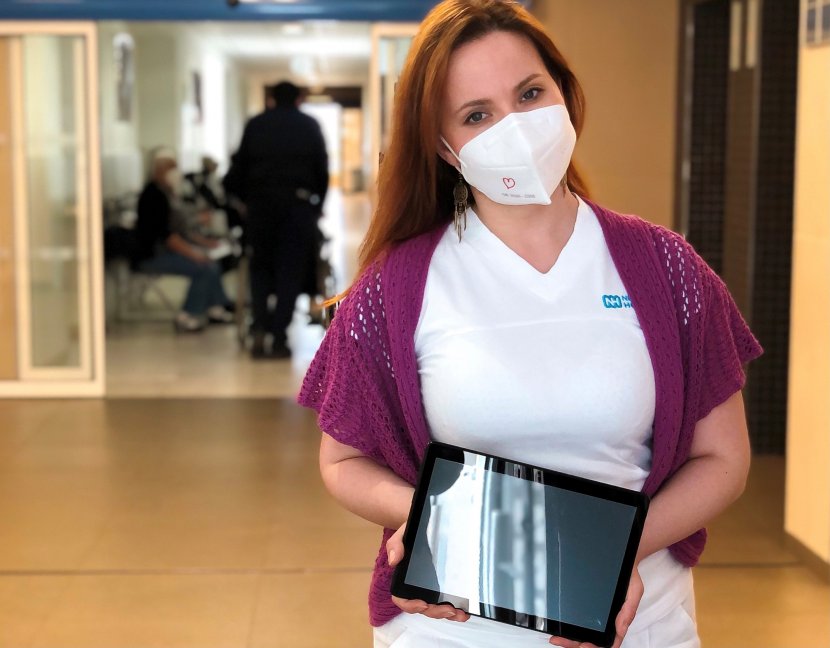
Last autumn, as part of the hospital's palliative care team, we began to consider ways to support patients, families and staff in these difficult times. As we strive to care for our patients with all of his or her needs in mind, we decided to purchase tablets to enable video linking with families and loved ones to support the psychological side, which is equally important in the healing process. A total of three tablets were purchased and the necessary applications installed to enable video calls to take place. From the first moment it was obvious how useful and necessary this service is. All the families were very grateful for the opportunity to connect with their loved one.
In which wards can patients use them?
Patients in all inpatient wards of our hospital can use the tablet call mediation. We have a total of three tablets, and as a social worker, I keep one with me at all times so that I can meet the needs of patients and families anywhere in the hospital at any time.
How can patients arrange a call with their family?
Absolutely anyone can approach me with a request for contact. Patient, family, doctor, nurses, paramedics. It doesn't have to be a specific request. It can be a suggestion like the patient is sad, remembers the family, doesn't have a phone. If a doctor or other worker who is in daily contact with the patient gives me this information, I can work with it further, visit the patient, call the family and offer them a video call. And it's not only these calls, but also, for example, someone from the family sent me photographs that I could then look at together with the patient or perhaps read a letter.
In practice, it then looks like the family calls me to say that they are interested in hearing and seeing their loved one. Or a doctor calls me that the patient would like to see the family. Based on this, I arrange the specific details with the family - the date of the connection, the approximate time, and also the app we will use for the connection (most often we use whatsapp, but we have also connected via messenger, viber or skype). If we already have everything we need arranged, nothing prevents us from making the call. I will visit the patient in the room at that hour and we will connect the call. I stay with the connection for assistance, sometimes I need help with communication, etc. The frequency of the connection depends on the agreement. Sometimes we connect once, other times it is 3 times a week for several weeks. It depends on the specific situation and the family, we try our best to accommodate everyone who is interested.
More often than not, I connect older patients who either don't have a phone at all or don't have a modern device that allows them to video call. Even a patient with impaired consciousness, a patient who does not communicate verbally or a patient who is confused is not a barrier to connection. Here again, the connection can be very helpful as it can be supportive and beneficial to the patient's psychological well-being to hear a familiar voice, but also to the family as reassurance that their loved one is doing well. Because visits are severely limited on all wards, we connect patients with covid but also with other diagnoses.
How many patients have already used this service and what is the current demand?
The period from October 2020 to April 2021 we have linked over 150 calls in total for 54 families. After that there was a relatively quiet period when arrangements were relaxed and it was possible to attend in person to see your loved one, so interest in the service waned.
Currently, due to the epidemiological situation in our hospital, a ban on visits is again in place and we are still offering this service in the hospital. Anyone can request it during their hospitalisation.
The service is free of charge for patients and families. The standard connection is available between 8am and 4pm on weekdays. However, other times or weekends are also possible by appointment.
|
Contact: Bc. Hýlová Lada, health and social worker at Hospital Hořovice |