Česky
Česky


What is your experience in dentistry so far?
I have been working as a dentist since 2010, when I bought a practice in Jablonec nad Nisou from a local dentist who was retiring. I restructured, renovated and equipped the practice with modern equipment. After a year of operation, we hired a dental hygienist and another dentist, and in the next two years we were working in a small office with a team of three doctors and two dental hygienists in shift work. After seven years of work, we built a modern dental clinic in the centre of Jablonec. We currently have eight dentists, five dental hygienists, our own dental laboratory and we strive to provide the best dental care to the residents of Jablonec and patients from the surrounding area. My main areas of expertise are fixed prosthodontics, dentoalveolar surgery, periodontics and implantology.
It is with regard to the level of dental care we offer to our clients in Jablonec nad Nisou that I was approached by the management of AKESO Holding to see if I could help with the modernisation of the dental department at Hospital Hořovice.
What will be the scope of your work at Hospital Hořovice?
My work for the hospital has several parts. At the moment we are dealing with the purchase of more modern equipment for both the dentists and the dental laboratory in the hospital building. At the same time, we will introduce new procedures and methods that will make the operation and needs of the dental laboratory department more efficient. My work to date has consisted of analyzing the current state, designing instrumentation upgrades, and training existing staff in new technologies. We are now trying to reorganise everything so that the set procedures are as efficient as possible for both the department staff and the patients. We would also like to expand the range of procedures to include, for example, implantology, bone reconstruction or periodontal surgery.
What new equipment is planned to be purchased?
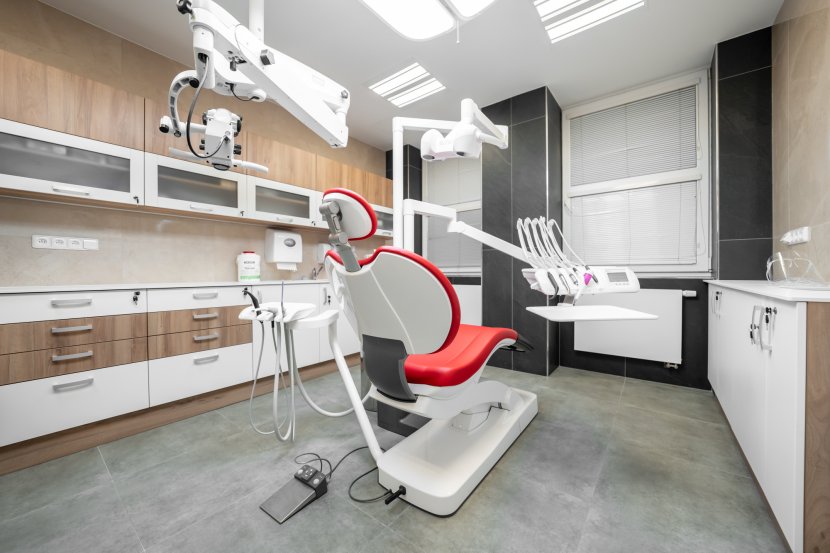
There will be a new CT scanner (low dose dental CBCT), an office scanner, operating microscopes, microsurgical instruments, dental hygiene kits and a fully digital dental laboratory working with the best materials.
Will the dental department be expanding in terms of staff?
We would like to expand the team by adding dental hygienists as we want to focus mainly on periodontitis therapy. We are also considering adjusting the office hours. In Jablonec, for example, it has been very good for us to work 6-hour shifts, where one hygienist works from 7 a.m. to 1 p.m. and the other from 2 p.m. to 8 p.m.
What are the trends in contemporary dentistry?
Dentistry is constantly evolving both in terms of procedures and technologies and materials. It is absolutely essential to work with magnification (magnifying glasses, microscope). Dentistry is a modelling science. One needs time, magnification and precision. The trend is to simplify, speed up and digitise procedures. We use technology to help us. We use intraoral scanning instead of conventional imprinting in plastic, and imaging of hard dental tissues and bone is now possible in 3D using a CBCT machine, which has very low radiation, comparable to a conventional X-ray. Of course, the process is fully digital on the dental laboratory side.
Are you taking inspiration from abroad?
Certainly, but the level of top dental workplaces in the Czech Republic correlates with abroad. I would definitely not say that we are lagging behind in anything.
Is there a procedure in your profession that you like most?
I like working on bone reconstructions the most. What is unique in our country is bone reconstruction using autologous bone (the patient's own bone), where I do not use foreign material (bone and membranes from animals or artificially created mineral granules and membranes). With the use of foreign materials, the surgical outcome can be highly unpredictable and the procedure takes longer and is harder to heal.
I attended a course with Professor F. Khoury in Germany, where the patient's own bone is removed and processed, and this is used to reconstruct the missing tissue for the subsequent insertion of a dental implant. We also use the patient's blood from which we can create membranes for use in surgery. These methods are as gentle as possible for the patient, healing is fast and the outcome is predictable and stable.
Was dentistry always the field you wanted to study?
Yes, my parents are doctors, my dad was a model maker in his spare time and I enjoyed that as well as drawing. Dentistry is largely an artistic field, a combination of manual dexterity, spatial imagination and medicine. What I enjoy most about being a dentist is seeing the immediate result. I like the change in condition before and after the procedure, nowadays standardly captured and documented by photography.
Most people are afraid of the dentist, they are afraid of the pain. Do you have any advice on how to avoid this?
This should be a thing of the past nowadays, any examination or treatment that might be even a little painful is already done under anaesthesia. Even major procedures such as bone reconstruction are done under local anaesthesia. For timid patients, of course, treatment under analgosedation is also possible, but here the hospital environment is a great advantage.
Do you take a break from your demanding work with an active lifestyle in private?
The moment I started my practice, I stopped modelling. You need a break from the hard work and concentration. The work of a dentist is physically and mentally demanding because of the high level of concentration. Aside from relaxation and good physical condition for dental work, it is essential to play sports. I practice gymnastics, tai chi and martial arts. I like technology and fast cars.
Source: NÉA 13, Text: Petra Horáková, Photo: Jan Vlček