Česky
Česky


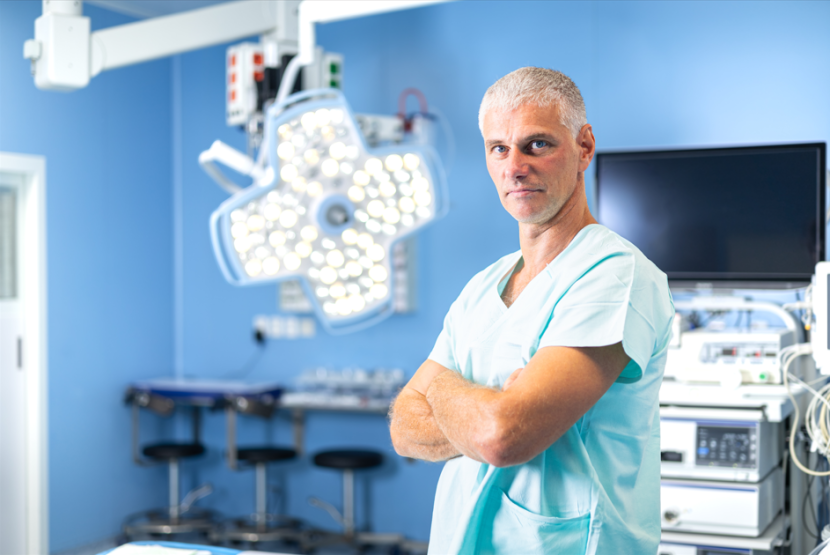
What led you to surgery in the first place and how does one become a military doctor?
I was interested in medicine since I was a kid, my friends even called me "doctor" as a joke. I first encountered surgery when I was about six years old. I remember being very impressed by Dr. Motyčka from Rychnov nad Kněžnou, who treated my broken elbow. His approach, gentle hands and sophisticated speech appealed to me a lot even as a little boy, and I decided then that I would become a surgeon. Then, when I was in medical school deciding which field to pursue, surgery really won out in the end.
I became a military doctor by studying a combination of the Jan Evangelista Purkyně Military Medical Academy in Hradec Králové and the Faculty of Medicine of Charles University in Hradec Králové. My father was then in the service in the forces, working as a fireman - a unit commander. We talked about the advantages and disadvantages of working in the state forces, and I was interested in the possibilities the army offered. I won't hide the fact that there were financial motives, but the offer of extension courses, the better educational opportunities provided by the army, or the possibility to play sports also played an important role.
How long did you stay in the army?
A full 27 years, much longer than my commitment to the army. I also completed three tours in Afghanistan.
Is war surgery much different from civilian surgery?
One thing is the professional side of medicine, which is really different on missions. War medicine has its own specifics and approaches that need to be known and practiced, which is very difficult in peacetime conditions. But also where you are, what environment you are in, what the security situation is like and how it all affects you plays a big role. On every mission you always put on a lot of character, you test your indomitability. Some missions are "cool", which is of course meant to be hyperbolic, but I've done missions where Czechs have died. I knew them, we talked about our lives, and that's always hard afterwards. Of course it hits you.
Wasn't it difficult for you to come back to the Czech reality? Didn't the problems here seem petty to you?
First of all, it should be said that the army takes very good care of the soldiers, monitors their health and psychological state after the mission, gives them time to acclimatise and offers them help if necessary. I passed the tests after all the missions without any problems, in fact, I could immediately stand behind the operating table precisely because I found the problems here a bit petty. Sometimes we Soldiers find it ridiculous what is dealt with here, that a big problem is, for example, a blank paper.
I would also like to point out that the psychological burden is not just on the soldier who is the focus of attention, but sometimes it is much more challenging for the partner at home who does not always have complete information and is very stressed before it gets to him. For example, my wife read a news report in the newspaper that something had happened at our mission site, but she hadn't gotten the report from me yet because our phones had just been turned off or we were in an area with signal interference.
How hard was it for you to repeatedly go back on a mission when you already knew what you would be getting into again?
I went on my first mission as a young surgeon and had the opportunity to work under Professor Rysky, then head of the Central Military Hospital in Prague. I was able to operate with him and that gave me a lot professionally. Professor Ryska was a great icon for me because he was a great gentleman, but at the same time a firm and hard man. But I can honestly say that after the first mission I said to myself that I had enough professionally, because I had the feeling that I had really seen everything, and moreover I was aware that death was really close to me.
But on the second mission, I was offered to lead the team, and that was something new again. And I wanted to try leading a team like I'd seen Professor Ryska do. I took the third mission mainly because of the responsibility I had to the Army and the other soldiers who rotate on missions. In short, a commander was needed, so I went.
Since this year, you've been the chief of surgery at Hospital Hořovice. How did the cooperation with AKESO Holding come about?
Until last year, I was the chief physician at the Military Hospital in Brno, and I had already announced my departure from the army, and therefore from the hospital. I had even secured a position in our hospital in South Moravia, only to be approached and invited to a meeting by Sotirios Zavalianis. I was tempted to meet him because I had read a lot about him and it appealed to me. The owner gave me three hours of his time and presented his vision and how he takes care of his employees. Based on this conversation and after talking with my wife, I decided to move to the Czech Republic for a year, my family will stay in Moravia for now and we will see next year.
Are you planning any new things at the surgery?
We have already started to try the first novelty. It is a robotic arm, which can be used instead of an assistant in some laparoscopic operations. A more substantial and more expensive technology that I would like to work with already this year is a robot for robotic-assisted surgery of the bowel, stomach, hernia and others. I already have experts on my team who can operate with it. In labyrinthine terms, a non-sterile surgeon sits at a table, gets joysticks in his hands, has pedals under his feet and operates on the patient at a distance. These tools control the individual arms of the robot, which control the instruments inside the patient. This surgery is much more delicate because the robot is very precise. This technology can even eliminate some hand tremors, so it can be operated even by surgeons of advanced age. We know from foreign sources that even quite old surgeons perform the operations very precisely.
We are not planning another big innovation yet. In Hořovice, high quality has been maintained for a long time and the latest technologies and modern consumables are available to us. For example, we use stem cells, we have electric staplers or lasers, etc.
What vision do you have for your team?
Some doctors may be good in a large part of surgery and others in a narrower part, but their quality exceeds all others. For me, it is always important to have a team composition that covers the breadth but at the same time is very precise in the narrow profiles. In Hořovice, I like the fact that we have very high-quality general surgeons and surgeons, but also specialists in colorectal surgery, IBD surgery, which deals with non-specific inflammatory bowel disease, bariatrics and mammology. We achieve a very high quality in these fields, so patients come to us from all over the Czech Republic. We also have plastic surgery and hand surgery externs who also have a high standard and a very good reputation. This is where I see potential and where I will continue to lead and develop the surgery.