Česky
Česky


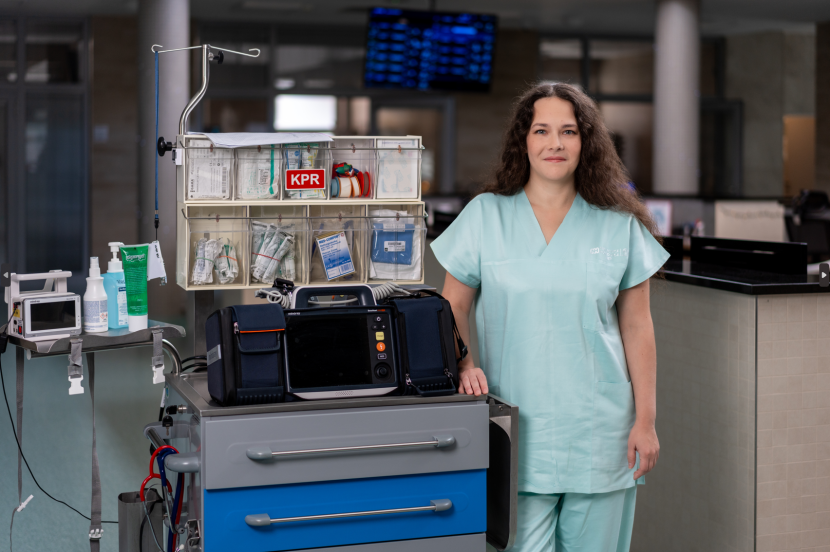
Doctor, congratulations on your success. How do you feel about this award and who is giving it?
The FERC title is awarded by the European Resuscitation Council to professionals for outstanding contributions to resuscitation science and education. For me, it is special because it recognises the work I have been doing for a long time and for which I am leaving my family. I am glad that my efforts, to which I volunteer much of my free time, are meaningful to someone other than myself.
But so far only about 130 people worldwide have received FERC, and only 20 of them are women.
It does. In the Czech Republic, two paramedics have received it before me, and there are five other awardees from around the world involved in pediatric resuscitation.
Which is not many. Since when have you been doing resuscitation?
The initial impetus for me was my internship in paediatric A&E. We regularly dealt with life-threatening conditions for our patients there. The next was the European Resuscitation Council (ERC) certified course, which I attended in 2012. At that time, only courses focused on resuscitation of adult patients were held in the Czech Republic. I liked the fact that they approached the issue differently than how we were taught in medical school.
How were the courses different?
What was new at the time was to approach a critical situation according to system priorities rather than a presumptive diagnosis. Teamwork was also very innovative, which had not yet been trained here. In the ERC courses, we were taught that we are one team and every role in it is important. No matter if someone is a doctor and someone is a paramedic. Because all roles are important. And only when we work as a team can we achieve good results in resuscitation. At that time I was sorry that we did not have a similar course in the Czech Republic focused on pediatric patients.
So, in 2014, you attended an EPALS (European Paediatric Life Support) course abroad, focusing on the recognition and treatment of the critically ill child. Then you became an instructor and initiated the creation of certified courses in paediatric resuscitation in the Czech Republic. Who is this course for and what will you learn?
The EPALS course is exclusively for healthcare professionals who are expected to be involved in the resuscitation of a critically ill child in the first 30-60 minutes. Whether in hospital or in pre-hospital care. The aim of the course is to equip participants with the theoretical knowledge and practical skills necessary to care for a child with respiratory or circulatory failure due to various causes, and to prevent the progression of a critical condition to cardiac arrest.
Who is most likely to attend an EPALS course?
The most common attendees are physicians of all specialties, especially emergency medicine, anaesthesiology and intensive care medicine. In addition, paramedics and nurses working in intensive care or resuscitation units, operating theatres, hospital emergency departments or ambulance services. The prerequisites for participation in the course are clinical practice and completed medical education, such as graduation from a university or college of health sciences, a secondary medical school or a medical school.
Where in the Czech Republic do you train and how often?
Currently we train in Brno and Hradec Králové. The training centre must meet certain requirements. For example, you must have enough erudite instructors - able to resuscitate and also able to train other doctors in it. In the courses we also teach how to stand up to the patient and also how to put together the resuscitation team itself. In addition, with paediatric patients it is not only about mastering the resuscitation itself, but also critical conditions. These are relatively rare in paediatrics, and people are even less prepared for them. And that's what an ERC course can prepare you for. It teaches you a structured procedure that immediately pops into your head in a critical situation, and then you just go as you've rehearsed.
CPR in children has more pitfalls than in adults and the results tend to be generally worse. Why is that?
We don't know for sure. Pediatric patients don't usually have a sudden arrest like an adult who collapses suddenly somewhere. An adult often collapses seemingly from full health. This means that he has oxygenated blood at the time of the arrest and if you start resuscitating him right away, he has a chance of a reasonably good outcome. In children, most arrests are so-called secondary arrests, where they are preceded by a critical deterioration in health. In addition, paediatric arrests are very infrequent. Of the total number of arrests, only 0.8-1% are paediatric. A large proportion of health professionals are therefore not as well prepared for them as they are for adult patients. These are also very emotionally demanding situations. Most children who have suffered a seizure are less than one year old.
Can seizures in children be prevented?
In part, yes, by early diagnosis. For basic identification of a critical child or a child who could potentially be in a critical condition, we observe skin colour, breathing and behaviour. For breathing, we look for anything that is not normal - for example, additional sounds, breathing too slow or too fast, or breathing stops. As far as skin colour is concerned, if the child is greyish or bluish, the parent should seek professional medical help immediately. For behaviour, we look for anything unusual - for example, extreme crying for no apparent reason or, conversely, if the child is unusually quiet. There is a fourth indicator that is important to us as doctors - a parent who shows great concern that something is wrong with the child. Because the mother or father is with him most often and quite quickly recognize when something unusual is happening with their offspring.
You are the head of the ERC's Committee on Science and Education in Paediatric Resuscitation. You're involved in the development of recommended practices. How often do you update them? Who follows them?
We update them on an ongoing basis. The summary of recommended practices comes out once every five years, which is this year. The standards are then adopted by the resuscitation councils of the different European countries. They then disseminate them to healthcare professionals in certified courses. The standards are also taken into account, for example, by forensic experts when they draw up expert opinions. The European Resuscitation Council is now also trying to bring the latest knowledge and practices directly to the public. It is therefore lobbying the European Parliament to make the CPR standards part of the teaching in driving schools, including the necessary practical training.
Is this necessary?
Yes. People are often trained only in theory. Practical skills - that is, having practiced CPR and being able to perform it automatically - are essential for critical survival. In other words, you have resuscitation not in your head, but in your hands. It is also important to incorporate the basics of CPR into primary school education. It is proven that even a child who has only one hour of CPR instruction per year can competently resuscitate and by the age of 10 can do so physically. By that time they are at least learning the sequence of actions to do. By the age of 10, they are already learning practical things - how to breathe into a patient, how to perform CPR. Moreover, he can pass on the acquired theoretical knowledge and practical skills to other family members at home. In Italy, Spain or Malta, they have already included resuscitation courses in their education systems.
How is it in the Czech Republic?
In our country, it is still very haphazard. In some schools, teachers teach resuscitation, in others they invite professional rescuers. It is definitely not a systemic teaching. We are therefore not sure how good the education and teaching in schools is and whether it meets European standards. We do not even know whether only theoretical training is provided in schools, or whether there is also practical training. This needs to change.