Česky
Česky


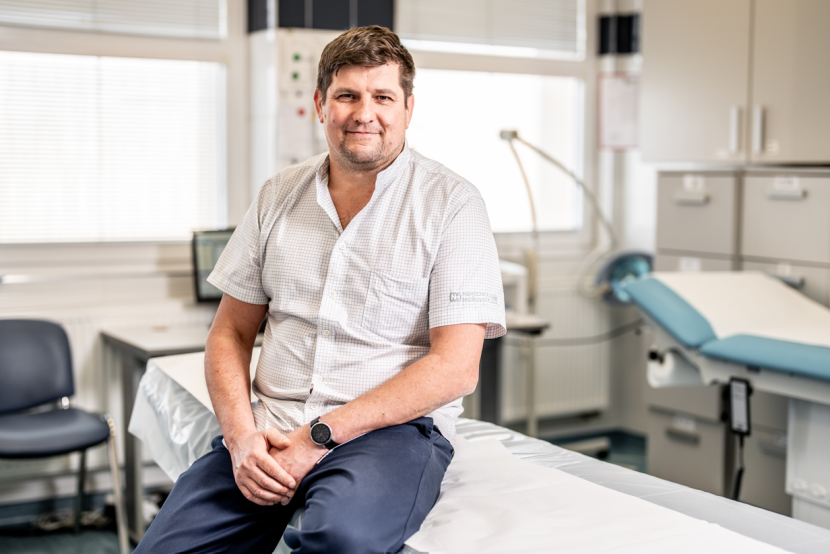
Last year you became the head of the surgical department. How long have you been working at Hořovice Hospital?
I joined the hospital on 1 January 2011, when I accepted the offer of the then director after 11 years in the hospital in Pilsen. This was preceded by a recommendation from my medical school classmate and friend MUDr. Jan Ševít. At that time he convinced me and my colleague from surgery, MUDr. Václav Šmíd, and I am glad for that. We both work here to this day, I am now the head of the department and Dr Šmíd is my deputy.
How has surgery in Hořovice changed in that time?
When I joined, the hospital was performing approximately 1,600 surgical procedures per year. Today - after 12 years - it is over 3,000 procedures. The change is not only in the increase in the productivity of surgical procedures. The direction of surgery was also greatly influenced by the previous head of the hospital, Zuzana Šerclova, MD, who introduced the IBD surgery centre in Hořovice, which was the flagship project of surgery during her tenure.
In what direction do you want to lead the department?
I would like to expand the focus of surgery in our hospital to other areas. We provide quality care in the field of colorectal cancer, classical surgery, whether laparoscopic or surgical, we have a developing mammology, which will hopefully expand even more in the future, we have recruited a new vascular surgeon and since January this year we have introduced bariatrics (note: procedures to address more severe degrees of obesity).
We intend to maintain IBD surgery. Under Dr. Örhalmi's leadership, we are able to perform almost all of the procedures in this area. However, after discussion with gastroenterologists, we would like to transfer some patients there. The aim is that IBD patients under surgery should be only those who need surgical solutions, and the actual treatment, which has its own specifics and solutions, should fall under the primary care of Dr. Voskha and gastroenterology.
How has the approach to the patient and surgical procedures changed during your time at the hospital?
I was still in the "old" surgery. Over the years, the hospital has undergone tremendous change. The environment we have here is comparable to Western hospitals. With a modern, friendly environment that makes patients feel professional and sympathetic, we are among the top. I have friends who come here after experiences abroad and they can't get enough of it. Another great advantage of our hospital is the excellent functioning of the collaborating departments, whether it is gastroenterology or radiology, where we have two CT scanners and sonography is available at relatively reasonable times. In terms of methods, there has been a move away from conventional surgery, particularly in the field of coloproctology, in favour of a laparoscopic approach.
"I admire our nurses for managing such a demanding job and for their enthusiasm."
What are the plans for surgery at Hořovice Hospital?
We are currently working on the development of coloproctology, headed by MUDr. Örhalmi, who is the chairman of the Coloproctology Section of the Czech Surgical Society, where we foresee robotic surgery in the future. The status of Pelvic Floor Treatment Centre will be applied for. At the same time, we want to expand the mammology clinic and increase the number of surgical procedures for bariatric patients. At the moment we are slightly limited by capacity, but this will change with the new hospital extension, which is now under construction.
What kind of procedures are most sought after in our hospital?
In terms of unscheduled procedures, the biggest boom is in trauma surgery. Of the elective surgeries, the treatment of perianal diseases, whether hemorrhoid treatment or fistula treatment, is much sought after by patients from a wide area. Quite a number of patients come to us for laparoscopic inguinal hernia repair, and mammology patients are among the most requested procedures.
Do we perform any unique procedures?
We don't perform procedures that they don't do elsewhere, but I now consider laser procedures for perianal disease to be unique procedures that are not common.
"Laser treatment of perianal disease is a much sought-after and unique procedure here."
What is the staffing situation in the department now?
In terms of doctor staffing in the department, we are relatively stable at the moment. I would like to expand our ranks with two more young doctors who have now been interviewed. At the same time, I have confirmed the recruitment of a doctor with a certificate in intensive care medicine, something I have been working hard to achieve. What worries us is the shortage of nurses. The nurses on our ward are working hard and have my admiration for how they manage to divide up the services, the care they give to patients and how they continue to be positive and enthusiastic.
What do you enjoy most about being a surgeon?
Like any surgeon, I most enjoy spending time in the operating room operating. The hardest part is encountering patient conditions where we know during surgery that the prognosis is not good, and the hopelessness is frustrating. When you know there's no hope, and you have to contact the patient's family. On the other hand, one is happy when the patient gets out of a bad prognosis. That's what recharges every doctor.
How do you like to rest?
Since I have three children, I try to spend all my free time with them. They give me the best mental rest. I also enjoy sports of all kinds, which we already do together, whether it is skiing or football. So when I'm not in the hospital, I'm usually on a playground.