Česky
Česky


When do you first meet the expectant mother?
Bc. Petra Jungwirth: Any time during pregnancy, as soon as the woman expresses interest in this service. If she wishes to do so after the first meeting, she stays in contact with her chosen midwife throughout the pregnancy until the birth and then during the six-week period. It is not uncommon for women to request individual care from their husbands.
How many of you are involved in the individual care programme? What do you do with the expectant mother?
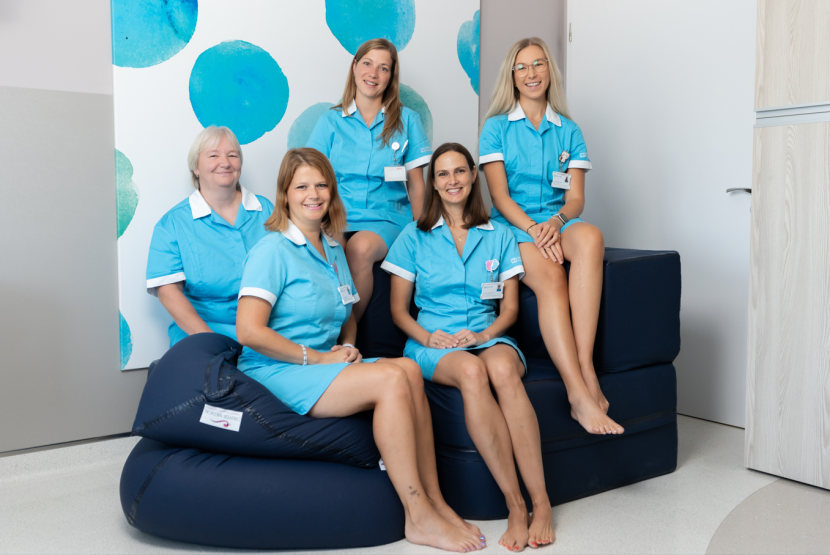
Mgr. Dana Roková: There are currently five of us. The basic package includes two sixty-minute meetings or consultations before the birth, then care during the birth itself, and it all ends with our visit to the client in the antenatal ward. However, depending on their requirements, we can extend the basic package with additional meetings and consultations.
What do you see as the biggest advantage for women when they are cared for by one midwife?
Mgr. Denisa Lukšíková: When we get to know the expectant mother or both parents during pregnancy, we establish a more intimate relationship than if we first met during the birth. We are also available to the client on the phone for individual care. This way she can contact you if she is unsure about something, has concerns, or just needs someone to talk to about what is going on. In addition to familiarizing the client with the birthing environment and giving her all the necessary paperwork to fill out, we can accompany her to appointments, visit during hospitalizations, and hold on-call during the time just before delivery. We are also in contact at the start of labour and arrive in the delivery room at the same time as our client.
Mgr. Dana Roková: Of course, we know her birth wishes very well, we have all the information about her, and that makes the admission to the operating room all the easier and shorter. Another great advantage is that we know the medical team from the whole hospital very well, and we communicate and cooperate with them throughout the care.
What is the demand for individual care?
Mgr. Denisa Lukšíková: It has only been two months since we launched this programme and we have already had the first happy new mothers and we are in continuous contact with others. The satisfaction is huge. It is already absolutely certain that the interest in individual care will continue.
For more information on individual care, please visit Individual Care for Parenting
You organise antenatal sessions for pregnant women. Can they also arrange individual consultations and a tour of the maternity hospital?
Bc. Veronika Beranová: Yes, they can. Individual discussions are great for couples who want to get to know the environment of the maternity hospital privately. First, we will discuss with the expectant parents how to register a pregnant woman for delivery (check-in), when to go to the maternity ward and what to expect. We will also give them the documents needed for the birth. We will advise them on what things to pack for the delivery room and what to pack for the sixth birth for the mother and what to pack for the baby. We then move on to the delivery room where we go through the reception of the babies and see the delivery box. Here we discuss birth times, show the equipment we use, talk about pain management options, and what to expect for mom and baby in the first two hours after birth. We end the discussion with a tour of the sixth-grade room and the cafeteria there, where moms can go for a snack at any time of the day or night. We offer muesli, fruit, energy bars designed for breastfeeding moms, dairy products and other goodies that we replenish regularly.
Do clients discuss birth plans with you?
Bc. Martina Zvolánková: Yes. We always talk about them. And we also ask every mother if she has any specific wishes. Most of the time she wishes for what is common and standard in our country. Often the mother herself comes to the conclusion that we will agree on everything according to the situation and there is no need to write down a birth plan.
What can women in labour use for pain control in the Hořovice maternity hospital? What are they most interested in?
Bc. Petra Jungwirth: We offer a variety of methods for pain control. The first ones we always choose are non-pharmacological ones such as hydrotherapy, aromatherapy, heat application, vaginal douching, positioning, massage or music therapy. Of the pharmacological methods, we can offer spasmolytics to parents at the very beginning of labour to reduce too strong uterine contractions. There is a great interest in epidural anaesthesia. We also have drugs for intravenous administration - i.e. into the vein. At the end of labour, the parturients make extensive use of inhalation analgesia - Eden gas (Entonox). They are very satisfied with it.
Can mothers move freely during labour?
Bc. Martina Zvolánková: Of course. General movement and positioning are an integral part of the physiological course of labour. The mother can also move freely in the case of epidural anaesthesia or during fetal monitoring (CTG), when we use telemetry probes that are wirelessly connected to the cardiotocographic monitor.
What positions do they most often deliver in?
Mgr. Denisa Lukšíková: It always depends on the preferences of the parturient, her physical fitness and the overall course of the birth itself. They can give birth in a semi-sitting position, on their side, or even on all fours.
What aids can they use?
Mgr. Veronika Beranová: We have a variety of aids. Whether it's gymnastic balls, small rehabilitation balls - overballs, mats or heating pads. A popular one is the Combitreck, which is a mobile birthing system that supports natural gravity and thus helps the natural course of labour. Of course, we also have a birthing stool and most recently a birthing couch. This is a big trend in all maternity hospitals now.
Can you talk about how women use the birthing couch?
Mgr. Dana Rokova: In the first period of labour, mainly to rest. It is wider and more comfortable than a birthing bed. A woman can take many positions on it, in which her partner can easily support her. On the birthing couch, she can even give birth to the baby herself. The couch is then comfortable even for the first two hours after birth during bonding. This is a process where mum and baby are in close contact - preferably skin to skin, which helps to form their strong relationship.
You mentioned that you also visit clients in the postpartum ward...
Bc. Veronika Beranová: Yes, just as part of individual care.... I think it's very important for mothers. Often they have a lot of questions about the birth that it is good to answer together and explain why it was so. If this is not done, these unanswered questions can plague women for many years to come. I see this as a very important meeting, both for new mothers and for us, because we get feedback on our care.
Why should expectant mothers choose the Hořovice maternity hospital?
Bc. Petra Jungwirthová: Because all expectant parents deserve a friendly meeting, kind communication and individual approach. We try to meet the wishes of the birth mother. And of course we support a safe and natural birth without the need for intervention.