Česky
Česky


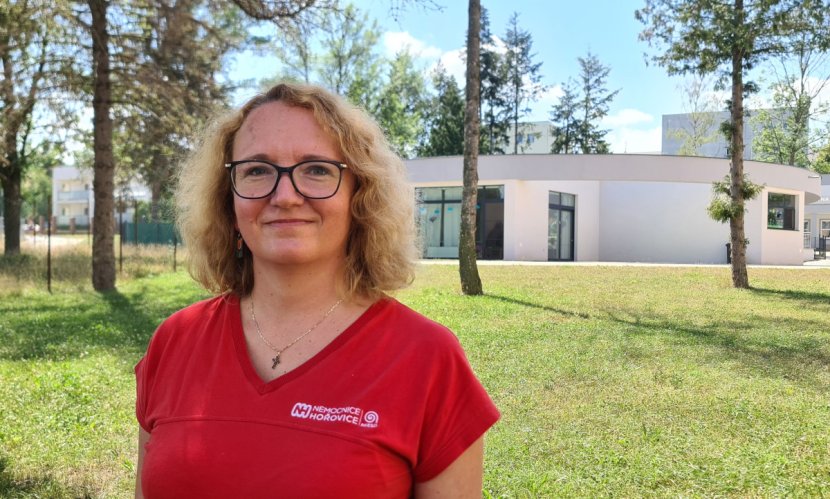
How did you come to work in the DIOP department?
I am a qualified physiotherapist, I have worked in an outpatient clinic for twenty years and have been in physiotherapy and private practice for some time. I have always been drawn to children. Gradually I came to believe that I would enjoy and find it professionally fulfilling to work in an inpatient ward. This job was waiting for me, although at the beginning I wasn't at all sure if I could handle such a job, especially psychologically. Even though I am a nurse, I had not come into contact with palliative care, especially children's palliative care. That's why I was worried. Even most of my family and friends were rather discouraged.
But you did it, and today you're happy...
I've found that the work brings me a lot of joy, you enjoy the little things you can do. You rejoice when you leave a patient and they're sleeping and breathing peacefully. He's pain-free. I'm very happy, I want to continue to do it a lot, to educate myself more, there's always something to learn. I've also learned a lot about myself.
How do you work with seriously ill children?
With children who are sentient, not in a coma, I try to make the exercises fun. When I can, I wrap the technique, which may be special, in a game or make it more interesting by saying nursery rhymes and poems and making different sounds. It makes the child's eyes light up and on the outside it looks like we're just fooling around. I also try to involve the parents, who I teach how to work with the child.
With comatose children, I do things like breath therapy, gentle contact therapy, I engage the whole body and all the senses. I'm completely attached to the baby, we snuggle, we bond through breathing. We breathe together. It can be important in diagnosis. It's a seemingly minimalist physiotherapy that can have a big effect. Breathing is the basis of life, in many sick children the intensity and depth of breathing changes, the breath shortens. Sometimes I just put my hands on the baby's body and it starts breathing, it's like a wave of a magic wand. The baby breathes through, calms down. For myself, I call it loving touch therapy, there's no technical way to call it that. I'm still touched, it's very nice work.
I don't think many people can imagine the process of physiotherapy in a coma...
There's a lot of options and techniques that can be used. It's very important for me to know the child's life before the illness or injury. I incorporate sounds, smells, vibrations, music and other sensory stimuli. I believe that these children perceive far more than we know than we think. A child who is visually and hearing impaired suddenly behaves differently when we are on the phone with parents and relaying different stimuli. Children who can't hear have a strong sense of vibration. I sing to them a lot, make different grunts, make intense sounds, while holding the baby close to me, body to body, the vibrations of the voice are transferred to the breath, the baby is beautifully leaning away, clearing his throat, calming down.
We sit and stand up comatose babies using various aids such as braces, special stools or strollers. It's important for the body to experience changes in position. Often it is physically very demanding work, but we are able to sit on the bed together with the unconscious body, for example in a Turkish sit-up or on an exercise roller. Of course, I have to be very careful and slow. It is important to estimate the right level of load, to monitor fatigue and not to overstimulate the patient. I must learn to recognize how the child reacts. Too many stimuli could trigger seizures, for example.
In the beginning, when the family comes in, I find out as much as I can about the child and the family, both from them and from other members of our team. For example, what the child liked to eat, what they played with, for older patients, what music they listened to. This will help give the children a sense of being at home. I'll apply everything in therapy. Sometimes I even dream about the work when a new patient comes in, I compose ideas, techniques, and play out what we're going to do. I have a lot of books at home and I'm always educating myself. Working here has also pushed me a lot in terms of medical knowledge. I recently completed a three-day intensive course, Introduction to Paediatric Palliative Care, which included the basics of communication in paediatric palliative care.
How are the parents involved in the care of the child here?
Children often come to us after discharge from the ICU, where they are in the most life-threatening condition. The care here is longer term, and the parents learn to care for the child themselves. If it is an initially healthy child, for example after an accident, the parents are often afraid to even touch the child, so as not to hurt it. I try to get them to connect with the child, to contact the child, but sometimes it is difficult. Together we overcome their internal barriers. Parents can't be blamed for anything, because sometimes even the health professionals are distant. A seriously ill child with various invasive inputs can seem frightening. At first, I too am cautious in trying to grasp the baby before I find out which touches may hurt him, what is uncomfortable, what bothers him, and conversely what is pleasant. Breathing techniques can also help parents to relax. The important thing is to stop being afraid of contact with the baby. This is extremely important for both parties. It is then a great experience for me when mum or dad first lie down in bed with the baby or sit down with it for the first time, managing to hold the limp body themselves. It's very emotional, when a parent experiences it for the first time, we all shed tears.
What do you find most difficult in your work?
More than working with the children, I was worried from the beginning about their surroundings, the parents who would not be mentally well, and I would not be able to communicate with them. In my job, it is specific that I am with children for an hour or more every day. I feel the parents very intensely, and they in turn feel how connected I am to their child, so they often confide in me about very personal things.
How do you work with your colleagues in the palliative care team?
My team colleagues and I have regular weekly meetings, and I work most closely with the doctors, nurses and hospital chaplaincy. It is very important to share information, to know what others are dealing with the family, what information the parents have been given. Often after talking to the chief nurse, it takes a while for the parents to absorb the information. Later on, in the room where I am practicing with the child, they need to add something, to ask something, often when the emotions come out fully here. I see communication with the parents as one of the most challenging aspects of my work from the beginning. It is also important to be able to share my own feelings with my teammates.
Can you think of something nice or even challenging that has happened to you at work?
When I started, my colleagues told me about a boy who came out of a coma, and I really wished something similar had happened to me. And recently, I witnessed a girl gradually waking up. It's not like in the movies, click and suddenly the child starts walking and talking and everything is fine. I noticed that the girl gradually started to follow me more, fixing her eyes on me. I could feel that the body was different during the exercise and showed something like active movement. Initially, the girl's parents did not know how they would manage care in the home environment at all. I will not forget the moment when together we saw their daughter moving her arms, legs, being able to nod, it was a wonderful moment. I told them that this was a great chance for them to take advantage of it. Today, the girl is rehabilitating very intensively at the clinic, she will go to the spa and is preparing for her final departure home. Her condition continues to improve and it looks like it could be very good. I was lucky enough to get this, it is a great gift for me.
But working in your ward also brings sad moments...
I always feel sad when my children leave... What is important for me is to say goodbye to my child, to allow myself to experience mourning internally, to go through a ritual, to light a candle at home. You have to be a little prepared for these things to come. I'm extremely grateful for the support of my family and my entire team, which I appreciate so much. It is the job of the palliative care team to make the best of the difficult situation that the family is facing. To provide them with a shared experience that the parents can remember as they grieve. So they don't feel guilty that they wanted to do something but didn't get around to it.
Source: Vlcek Family Foundation, www.nrv.org
Mirek Čepický and Michaela Šimková