Česky
Česky


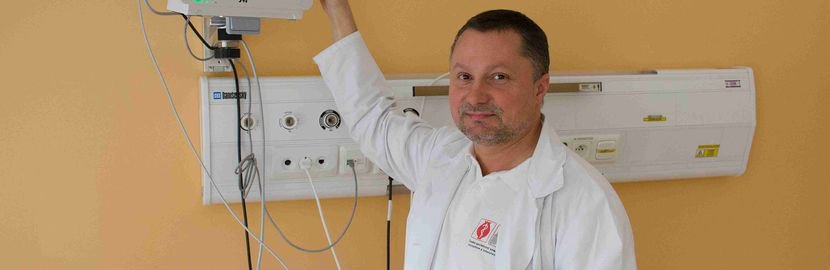
Chief, could you briefly introduce yourself to our patients? Where have you worked so far?
I graduated from the Faculty of General Medicine at Jan Evangelista Purkyně University in Brno and graduated with honours in the revolutionary year 1989/1990. As fate would have it, I eventually chose the Department of Anaesthesiology, Resuscitation and Intensive Care Medicine at the University Hospital in Motol for my start. Here, under the guidance of Professor Pokorný, I started to work in adult anaesthesiology. An integral part of my career has always been working in the emergency services. It was no coincidence that I started as a general physician in the paediatric resuscitation ward. Firstly, I was extremely interested in the intensive care of the paediatric patient, and at the same time I was guided by the personality of paediatric resuscitation care, Chief Karl Dlasek, who continued to shape my entire professional career, was my mentor and friend throughout and ultimately influenced my recent decision to participate in the establishment of the first chronic and intensive care unit for children in the Czech Republic.
What are your first impressions of the Hořovice Hospital?
When I first discussed with the director of Hořovice Hospital, Luděk Pelikán, the possibility of becoming part of the project to create a children's ICU, I was naturally interested in what kind of environment I would go to. After opening the website of the Hořovice Hospital, I appreciated the professionalism of the photographers presenting incredible sunlit views of the hospital, which I had already seen from the outside. Back then it looked rather outdated. But then I looked at the individual wards on the internet and, as everything looked staged, I came to the conclusion that an immediate personal visit was necessary. What was my surprise when the reality outside and inside matched the photographs perfectly! Everything was indeed brand new, sparkling clean and in full operation. I have visited many medical facilities in my life, both at home and abroad, and I recognize new functionally furnished spaces. At the same time, when I spoke to the director, I was assured that the hospital's philosophy is quite different from the megalomaniacal policies of the university hospital complex, based on close friendly relationships, individual cooperation and treating each individual patient as if they were the first and last.
I was very pleasantly surprised and the overall impression of the hospital had a major influence on my decision to finally leave Motol hospital and accept the offered position at the hospital in Horovice and become part of the project of the newly emerging OCHRIP for children... And it was really not an easy decision at all, believe me.
What plans are you coming to Hořovice with? What is OCHRIP?
The World Health Organization defines chronic resuscitative, intensive and palliative care for children as active and holistic care for the body, mind and soul of the child, of which family support is an integral part. Healthcare professionals must alleviate and remove the child's physical, psychological and social stress. Effective palliative care requires a multidisciplinary approach involving the child's family and usable social resources, which should be used successfully, especially when causal treatment options are limited. The patients who are referred for hospitalization in our department are quite diverse, but usually very seriously, sometimes terminally, ill. They are patients with different types of diagnoses chronically affecting basic life functions, whose support is still needed to varying degrees. For example, severe polytrauma with persistent sequelae, craniocerebral injuries with consequent effects on brain function and with varying degrees of impaired consciousness up to the level of apalic state or vigil coma, upper spinal cord injuries with inability of spontaneous ventilation, then a spectrum of neurological diagnoses, genetic defects, inborn errors of metabolism, inoperable congenital defects (most often cardiological), and last but not least, paediatric oncology patients in the terminal stage where treatment options have been exhausted.
When will your project start working - is there any interest in the republic for something like this? Have any similar projects been put into practice?
There is no such thing as a chronic resuscitation and intensive care unit for children in our country yet, although a number of facilities - including my mother's inpatient paediatric resuscitation unit in Motol - are substituting its function. Patients requiring paediatric ICU care are relatively numerous in the country and occupy acute resuscitation and intensive care beds that should be used for new acute admissions. Finally, it is disadvantageous for health insurers and the health system as a whole to pay high acute bed rates for these patients when proper care for them already falls into a different category. We are now in the final stages of recruiting qualified nursing and medical staff. We are finalizing the installation of the necessary equipment and fine-tuning the last operational details needed to get the entire department up and running. We are now planning to admit our first patient in March.
How will you ensure the smooth functioning of your project from a professional point of view? What is involved in caring for chronically ill children?
I must say that in the current economically certainly difficult situation, the hospital management has been fully supportive, both by creating optimal conditions for recruiting medical staff and for equipping our new department with the most modern technology. Chronic resuscitation care of paediatric patients is highly specialised and includes both theoretical knowledge and practical experience in ventilation of seriously ill children and many other skills used by both medical and nursing staff. Under the expert leadership of the head nurse Pavlína Hesounová, who coincidentally also came from the University Hospital in Motol, we have managed to create a team of qualified nurses and ensure comprehensive preparation of the entire department so that we can meet all the challenges that the opening of a new demanding department poses. All those who will be working with patients of this type must also be extremely mentally resilient, because in many cases the aim will not be to cure the patient, but to make the patient's inevitable departure from this world as comfortable and easy as possible, while helping other family members to bear the overwhelming burden of a seriously ill child.
What are the motives of the management of Hořovice Hospital for approving such a financially demanding project?
Resuscitation and intensive care for children is very financially demanding, both in acute and chronic form. However, it is extremely important and forms an inevitable part of the treatment process. Health insurance companies understand its place in medicine. In the area of adult OCHRIP, a system of reimbursement has already been established, and in the area of paediatric medicine, the plan is to establish sufficient reimbursement for this care this year or next year at the latest. There is therefore a realistic hope that the existence of OCHRIP for children will be fully taken into account and financially secured through health insurance companies in the near future.
What is the future of such a project in a relatively small regional hospital like ours?
The current rate of development of our hospital suggests that the scope of care already exceeds that of a regular regional hospital. We are reassured that our vision has a future by the fact that the moment news of the opening of the new children's OPD spread in the medical community, many colleagues got in touch with requests for the first patients to be transferred. We still had to turn them down temporarily, as we are not opening until March, but indeed: we are already virtually full and the number of requests for a suitable patient to be admitted exceeded our bed capacity in January. We can only wish that our efforts will meet these demands and create the conditions for the patients in need that we plan in our visions.