Česky
Česky


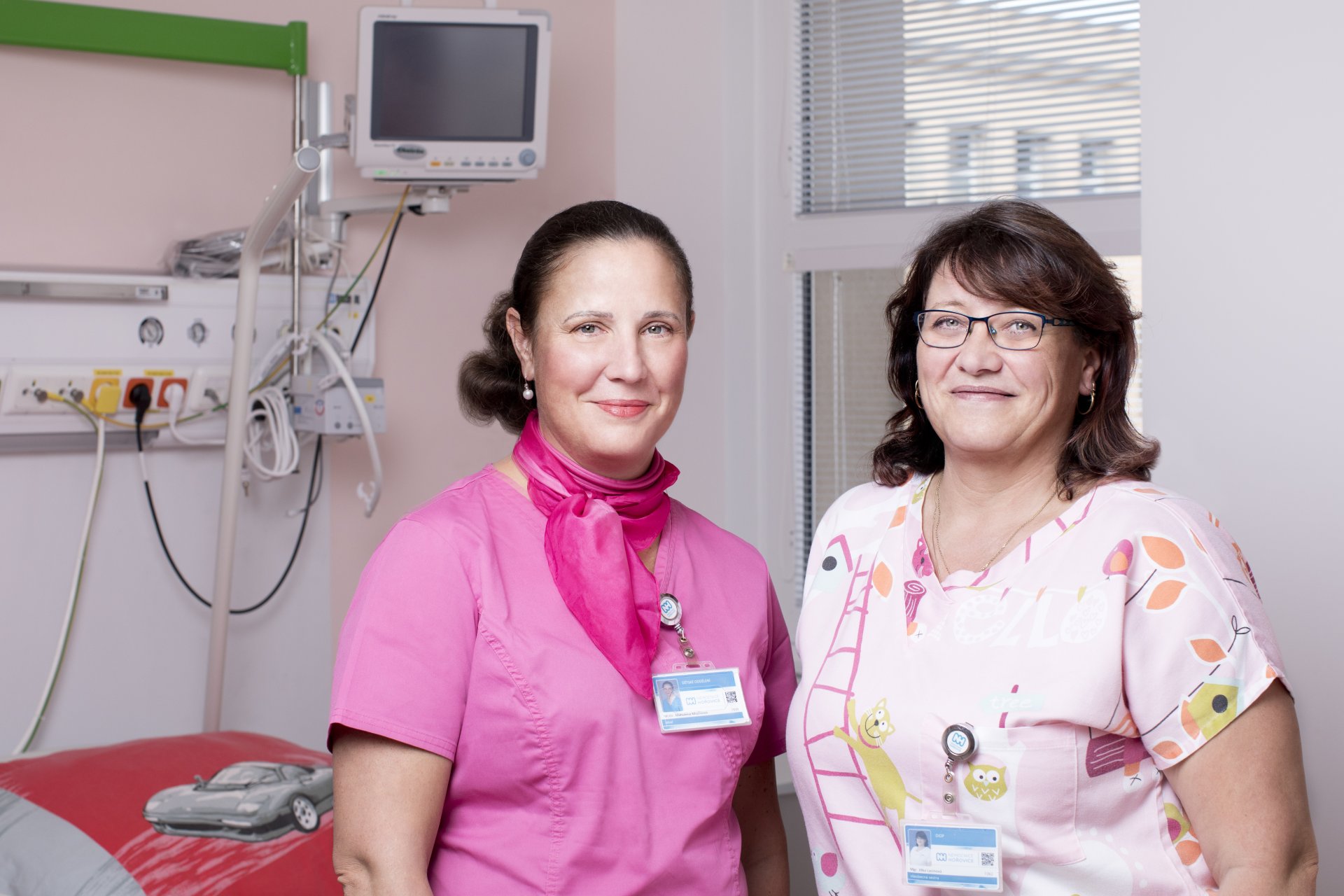
In the hospital in Hořovice you take care, among other things, of seriously and long-term ill children, i.e. those who have a low chance of surviving their childhood with their illness. You are also an external doctor at the home hospice Cesta domů, where you accompany children who are in the last weeks, or days, of their lives. Let me ask you first, what's the nice side of your job?
The meaning of it. Huge. Even when the situation seems hopeless, even when it's clear that a child's life is already short, we still have something to offer. Palliative medicine and care is not about dying, it's about trying to enable the best quality of life with a severe, incurable disease where there is no longer a cure or no treatment. Even though that span of life may be very short.
How did you become a palliative care specialist?
In intensive care, I often experienced liminal situations. Over the years there, many times you reach the limits of current medicine and the end of your capabilities. Not everything can be operated on, not everything can be fixed, even highly specialised care has its limits, not every child can be saved. I realized that you have to have something to offer even at a time like this. And that's how I got into palliative care. It is of course great for a doctor when his patient gets better or when his condition improves, but I became increasingly aware that it is important not to come up empty, even when the "healing medicine" has exhausted its resources. "I would love to give you what you want, which is your child's healing, but we don't hold that trump card. So let's talk about what we can do next to make your child's life better... to the end."
In Hořovice, you opened the aforementioned small long-term intensive care unit (DIOP) a year ago, the only one of its kind in the Czech Republic. What kind of illnesses and problems do you admit children with?
Especially children with congenital defects, metabolic disorders and very rare diseases. We have only six separate beds, six small rooms, so that someone close to the children can be with them - but they don't have to be with them either. Some children are with us for long periods of time, but more months than years; we also take children on respite stays, when we can relieve their family who have been intensively caring for a seriously ill child for months or years. And we also serve as a "transfer station."
A transfer station?
Between acute care in the hospital and moving home. Imagine a situation where a family has a perfectly healthy child, but something happens. An accident, for example, that results in a central nervous system disorder, where the child has severe and irreversible brain damage. The child has been in ARO and should go into home care, but the family is not ready - mentally, but also physically, they need time to set up a "new life", to rebuild the apartment, to buy a house, when the apartment cannot be rebuilt. These are emotional stories where everything is turned upside down from one day to the next. Such a family needs support, psychosocial help, needs to navigate the system of benefits, support and so on. So we offer them the possibility that the child is with us for some time, their relatives come, they learn to cope with care, but at the same time they have time and space to arrange everything at home.
And the last group...
For some children and their families, we are able to provide good care at the end of life, in hospital. Sometimes this is not possible at home, especially in regions where home hospice care, which is what Cesta domů is in Prague, is not available. We have already accompanied several children in this way...
What is the difference in palliative care at the end of a child's life on your ward and in a home hospice?
At Journey Home, I reach families who are usually "ready", they know the end is coming, so they reach out to us. There are more young patients with a cancer diagnosis where the doctors have stopped the anti-cancer treatment because it was no longer bringing any progress or possibility of a cure. The end is inevitable at that point. In the hospital, in our department, palliative care is part of the process of coming to terms with the diagnosis. Often these are very rare diseases for which it is difficult to determine the prognosis, because there are too few cases for any statistics, and often the condition develops differently than expected. Preparing the family for the possible end in such cases should begin at the time of diagnosis.
What is the path to the end? Not in a hospice, but in your hospital.
It depends a lot on when we get to the family, who has communicated with them before and how. For terminal illnesses with a poor prognosis, palliative care, as I indicated, should actually be part of the care from the beginning. We need to have repeated conversations with the family: what can we do for you? Now. Not a year from now.
You've been talking about the end being irreversible from the beginning?
The more open communication, the better. I don't like false hope. Tell it like it is. And how it will be with every change. "They can't see you anymore, but maybe they can still hear you." "He probably can't hear you anymore." "He's been having one pneumonia after another, you know what intensive care looks like. What do you want? What do you want for your child? Shall we continue with intensive care? Do we put him back on antibiotics? Do we put the baby on a ventilator?" Parents have the main say, but we don't want to put the burden of decision-making on them, we try to continually provide the best information possible so they can navigate and know what any decision might mean, and that can only be done with open communication. Something that might have made sense two years ago as the child's illness and condition progressed may not make sense now.
What do you mean?
At some point it is still a good decision to try to do the best you can to save a life, at other times it may be a better decision not to do the best you can... It doesn't mean that the parents have thrown in the towel or given up, but preferences in this area can change over time, with experience, with changing levels of difficulty and with possible suffering.
These must be difficult debates...
Difficult they are, but important. I explain to parents what it will mean if, for example, a child is intubated and put on a ventilator. That he'll breathe with it, but we may not be able to take him off it. And that at some point we may have to decide whether to stop ventilatory support...
I assume the parents want "everything" first.
Of course. Most parents want "everything" first. I'd want everything, too, to exhaust the possibilities. But if you start talking to parents about it, you'll come to conclusions about which options make sense and which don't. I'm a big believer in talking openly from the beginning. Your child is not going to get better, we can't do that, but we can do this or this and this when the first aggravation comes. A dad once told me when asked what he wanted for his sick child: "A new brain." He knew he couldn't. But he needed to say it. We can't give a new brain. Unfortunately. But we can do this and this and this and this... Or we don't have to. There's a nice little motto in palliative care that not everything we can do, we should do. At some point, it may not make sense to intubate and put on a ventilator, but to go home, take the baby to the Treehouse one last time. What parents couldn't imagine a year ago suddenly makes sense: a nice exit. Goodbye.
Mahulena Exnerová, after graduating from the 2nd Faculty of Medicine of Charles University in Prague, started working as a paediatrician in the ICU of the Department of Paediatric Surgery at Motol Hospital in 1997. Since 2014 she has been working as an external paediatrician in the mobile hospice Cesta domů. She has passed attestations in pediatrics, intensive care medicine and palliative medicine. She is a member of the committee of the Czech Society of Palliative Medicine ČLS JEP.
Source.