Česky
Česky


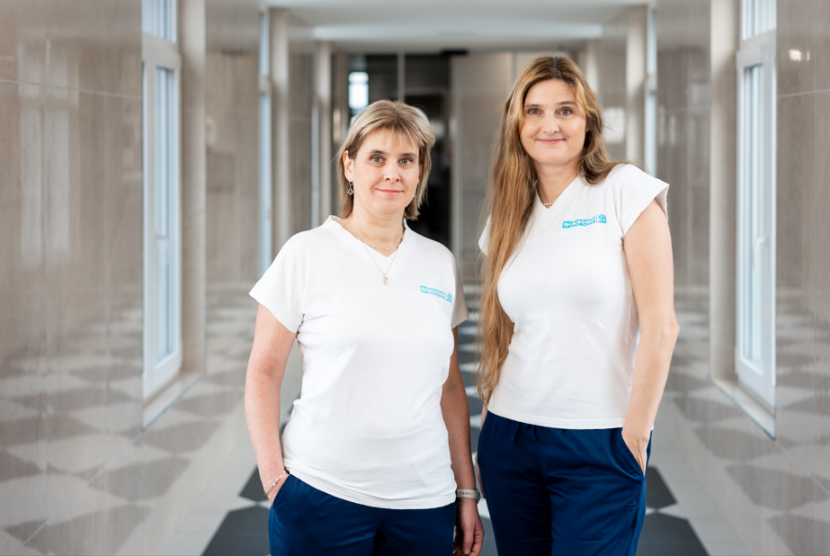
Madam, it has been more than 10 years since you and the doctor took over the management of the internal department of Hospital Hořovice in autumn 2014. How has it changed since then?
MUDr. Markét a Veverková. At that time we had 34 beds, including 6 intermediate care beds for patients transferred from the intensive care unit. We had 1-3 beds directly in the ICU. We now have 47 standard beds. Thirteen of these are in the neurology department. We also have 4 intermediate beds and another 1-3 beds in the ICU as needed. After the renovation, we have also got better equipment such as more modern ultrasounds or telemetry monitoring, which is more comfortable for patients.
MUDr. Jana Ziková: They can move freely around the ward and their heart activity is constantly monitored. The monitoring device they have on their chest is wireless. The data is transmitted from it directly to the central monitor.
So the inpatient area has grown and you've added patients...
MUDr. Markéta Veverková: Yes. Ten years ago, we were seeing 140-150 patients a month. Now it is about 240 patients per month. The average treatment time is around five days, which corresponds to the national average.
Who is your typical patient?
Jana Zikova, MD: It is a person of higher age, with several chronic diseases. With the increasing life expectancy, which is currently just under 83 years for women and 77 years for men, we tend to have more patients. The specificity of our field is a comprehensive view of the patient. We have to carefully assess the current situation and adjust treatment to match the trends of current medicine while not conflicting with the treatment already in place. I sometimes tell our young doctors that an internist is a bit like a detective. He has several clues that he gradually unravels in order to determine the cause of the disease and to be able to target the treatment well. A certain advantage of our department is that we know a large percentage of our patients. By the nature of their disease, they return to us. We know their medical history, their living conditions, we know their life story. We are often part of that story too, and we are pleased, especially when we cure them or at least achieve stabilisation of their disease.
How broad is the spectrum of diseases in which you specialise?
Jana Ziková, MD: Internal medicine is one of the basic fields of clinical medicine and is the backbone of the entire hospital. We deal with the diagnosis, prevention and non-surgical treatment of internal organs, not only within our department, but we also provide consultative examinations to all other disciplines in the hospital. The spectrum of our patients corresponds to current morbidity trends. Most have cardiovascular disease, cancer and diabetes. The most common diagnoses are heart failure, cardiac arrhythmias, hypertension, myocardial infarction or pulmonary embolism. We also treat diseases of the lungs, kidneys, digestive tract, haematological or infectious diseases. Internal medicine also plays a vital role in the care of the critically ill. They are treated in monitored ICU or intermediate care beds.
Have you also expanded outpatient care?
Markéta Veverková, MD: Yes. Several times a week she practices until 7 pm. We are trying to accommodate patients who work or would wait longer for an appointment. Once every 14 days we also do surgery on Saturday morning.
MUDr. Jana Ziková: In the afternoon, we do all internal examinations as standard, as well as procedures such as ECHO, ultrasounds, etc.
MUDr. Markéta Veverková: For blood donors, we do preventive examinations as a bonus. This is part of the programme that runs at the blood transfusion station. We finalise all the examinations. We also provide pre-operative examinations, we take care of cardiology patients. We also have a general practitioner's clinic.
MUDr. Jana Ziková: We also go to outpatient clinics in Královův Dvůr and in the Rokycany region - to Zbiroh and Radnice.
Which departments do you cooperate with within the hospital?
Jana Ziková, MD: The basis for successful work in such a complex field as internal medicine is teamwork, and this is already in our wards...
Markéta Veverková, MD: Within the hospital, we provide consultation services for practically most specialties. Mostly for surgical specialties, where we perform preoperative examinations and often also participate in the postoperative care of these patients. We also regularly cooperate with the cardiac centres of the Motol Hospital and the Na Homolce Hospital. We also work with gastroenterologists and palliative care at the Příbram Hospital. And also with the aftercare department of our sister Rehabilitation Hospital Beroun and the sanatorium in Dobříš, as well as with the pulmonary hospital in Janov, Rokycany.
How much has your team grown since 2014?
Markéta Veverková, MD: Our team of doctors has tripled.
MUDr. Jana Ziková: We have expanded it gradually, with the growing number of beds and outpatient clinics. There was also a period when we had to run the internal ward and the outpatient department with literally several people. Within our department, many doctors have already passed through the practice. We have recruited graduates and experienced doctors. Some have remained in our team, others have continued in other fields.
You mentioned that you're also recruiting recent graduates...
MUDr. Markéta Veverková: Yes. We have accreditations for internal medicine, both level I and II. In practice, this means that we can, and regularly do, accept graduates who are trained in internal medicine at both first and second degree level. Internal medicine includes sub-specialties that build on internal medicine. We have received accreditation for gastroenterology and Level I accreditation for diabetes and endocrinology.
What's the interest from graduates?
Markéta Veverková, MD: We get applications on a regular basis. Many of them stay with us. A certain problem is the regular departures of our colleagues on maternity leave, which extend over several years. We are all the more pleased when our colleagues return.
MUDr. Jana Ziková: We have also raised a large generation of general practitioners who work with us. It is a pleasant cooperation. Both sides know what to expect, how to be helpful to each other in caring for a common patient. Some GPs also collaborate with us in emergency care.
What is the next generation of internists like?
Jana Zikova, MD: We would like it to be as large and diverse as possible. In our department, as part of the training system, we meet many aspiring physicians who want to practice in internal medicine and related fields. Young doctors today have more choice in the choice of the medical institution where they want to work and train. This is a big difference, for example, compared to us, as typical representatives of the generation of Husák's children. We had a hard time finding any kind of job after school, especially in our preferred field. The path to obtaining a final education in internal medicine takes several years. It is a challenge especially for female physicians, who are the majority in our field and at this time are starting families and have young children.
Markéta Veverková, MD: We are happy when they come back to us and we try to support them. It is a matter of course that they have part-time jobs and they have a kindergarten right on the premises of the hospital. I see these doctors as a guarantee of continuity of care in our department in the future.
You have been running the internal ward of Hospital Hořovice together for more than a decade. What plans do you have for the next years?
Jana Ziková, MD: Our goal is to have quality doctors with internal certification, and at the same time to offer conditions for young doctors to prepare for a career as a specialist after graduating from the internal medicine department. The presence of specialists within the internal medicine department, who will form a team together with internists, has the chance to maintain a high level of treatment for seriously ill patients. Currently, those interested in diabetes and endocrinology or gastroenterology can train in this way.
How do young internists differ from their predecessors?
Jana Ziková, MD: It is difficult to generalise in what ways the incoming doctors are different and in what ways they are the same. Today, for example, there is a lot of talk about representatives of the so-called Generation Z - people born from the mid-1990s to 2010. They are currently our youngest colleagues. They have grown up in the world of the Internet, they have a different view of the world, different priorities. They can find the information they need instantly. They are more tolerant, they have a liberal view of the world, they care about maintaining work-life balance in their jobs. These are things that are rather inspiring and should be taken seriously. Our job is to teach them how to work with the information they have acquired so that they do not judge a patient solely on the basis of lab numbers and imaging results. They need to learn to see and assess the patient in person, to reflect on the patient and to put the results of the examination into an overall context. In the context of the new generation of physicians, there is general talk about their need for free time as a priority. But I have to say that if the situation demands it, they often stay at work long after their hours are over. Responsibility and concern for the patient, cooperation within the team, that is what I hope does not change.
What innovations are you planning this year?
We have expanded care for patients with diabetes and endocrinology issues. We have a new podiatric nurse, nutritionists, larger facilities and new equipment. We also plan to open a nephrology outpatient clinic for adults this year.