Česky
Česky


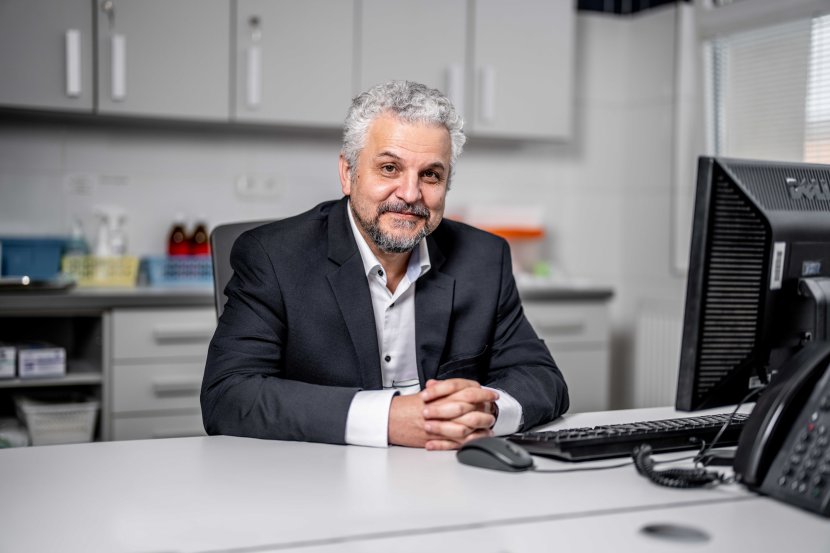
Colon cancer or colorectal cancer is one of the most common cancers in the Czech Republic. Approximately eight thousand new cases are diagnosed each year. If people went for colonoscopies, it would save many lives. "The asymptomatic period of colorectal cancer can last several years," warns Július Örhalmi, a physician.
The typical colon cancer patient, unfortunately, is not, in doctor Július Örhalmi's experience. "Colorectal cancer usually affects older patients over 60 years of age and more often men. But it also occurs in young non-smokers with an active lifestyle. Here, however, it is often linked to a mutation in one of the genes," he says.
A chance to detect colorectal cancer early is through preventive screening. Here, the doctor says, colonoscopy is clearly the most reliable. "In fact, a patient with a negative result in the occult bleeding test may still have a tumour," he warns. He adds that ultrasound cannot detect a tumour and CT scans, on the other hand, may not detect a small tumour at an early stage. This is what is important in the treatment of colorectal cancer. If the tumour is detected early, the success rate of treatment is very high.
"There are big differences in five-year survival between clinical stages. While around 90 per cent of patients achieve five-year survival in stage 1 and 2, this is already 58 per cent in stage 3 and only 14 per cent in stage 4 - i.e. with the presence of distant metastases," says the proctologist.
Bleeding doesn't have to be just a symptom of cancer.
Unfortunately, colorectal cancer is tricky in that it manifests itself very subtly until the more advanced stages, and many people confuse it with haemorrhoidal disease, according to doctor Julio Örhalmi. Moreover, there are no symptoms in very early tumours.
"Later, more frequent bleeding during stool may occur, it may not be pronounced and may not even be freely observed. It may be the presence of mucus in the stools, change in the character of the stools, alternation of constipation and diarrhea, more frequent urging to stool, lack of appetite, loss of weight, pain, anemia, loss of physical efficiency, fatigue. Unfortunately, all the above symptoms are present only in more advanced forms," says the doctor.
And what would proctologist Július Örhalmi recommend as the ideal prevention against colorectal cancer? "Itis definitely getting enough exercise, watching your weight, getting enough fibre in your diet, limiting alcohol and smoking."
There are currently about 50,000 patients with colorectal cancer in the Czech Republic.
"The incidence of colorectal cancer is 77 cases per 100 000 inhabitants. The mortality rate is 35 per 100 000 inhabitants. Globally, men rank 13th and women rank 21st-23rd in the incidence of colorectal cancer, a significant improvement from 2012 when men ranked 3rd globally and women ranked 10th," the doctor added.
Source: iDNES.cz website, Petra Barochová, 14 February 2024