Česky
Česky


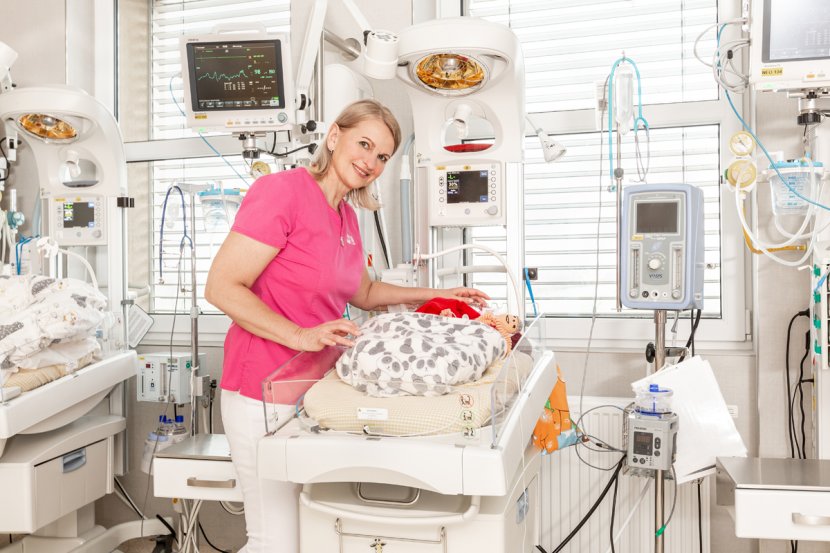
The maternity hospital in Hořovice has a long-standing tradition; it has been in operation since the 1960s and has long been the largest maternity hospital in the Central Bohemian Region. Fifteen years have passed since June 1, 2011, when neonatologist Dr. Milena Dokoupilová joined the well-run municipal maternity hospital, which handles 1,400 births annually . She accepted the offer from the owner of Hospital Hořovice, Ing. Sotirios Zavalianis, with great respect but also with determination.
Four years later, in 2014, the Hospital Hořovice was granted the status of a Perinatal Centre for Intermediate Care after meeting the required criteria for both neonatology and the obstetrics and gynaecology department. In 2015, a brand-new neonatal intensive care unit was opened, and last year the facility was accredited by the Ministry of Health of the Czech Republic as an Intermediate Care Perinatal Centre, with the requirement to fill the position of a perinatologist.
The Hořovice maternity hospital is thus one of 27 centres in the Czech Republic capable of caring for premature infants (born before the 37th week of pregnancy) —specifically, they care for newborns from the 32nd week of pregnancy, or from the 30th week depending on the situation. But forget about a cold and gloomy hospital environment. In Hořovice, they’ve managed to create a pleasant place that feels just like home. Here, both parents are actively involved in caring for even the tiniest babies from the very first moment.
And on this occasion, we sat down with the chief physician for a brief interview.
Have you ever regretted leaving a renowned centre to go “out in the sticks,” where there was only a small-town maternity ward?
My departure from the renowned centre took many people by surprise. But you’d be surprised—I’ve never regretted it. It even surprised me. I thought I’d miss caring for the tiniest patients weighing around 500 g, but I discovered that caring for the slightly larger ones is also very important and meaningful. I accepted the offer to work in Hořovice as a great opportunity to put to use the knowledge and experience I’d gained over 18 years at one of the best centres in the Czech Republic, the maternity ward at Apolinář Hospital. Getting the chance to build a completely new department from the ground up and put together a team of people—including physicians, but especially nurses—was a huge challenge, a lot of work, and a great deal of responsibility.
What was your vision for the new department?
I tried to create a unit filled with calm and understanding. I know that the care provided is the most important thing, but the environment in which parents will spend—sometimes even several weeks—can make the situation a little more pleasant. The needs of moderately and mildly preterm infants are different from those of infants born at earlier gestational ages. Most of them just need peace, warmth, their parents’ embrace, and, above all, a lot of patience. The goal was to place premature babies in a room with their mothers as soon as possible. Equally important was ensuring that these children would not have to be transported to Prague, where parents from our region had previously been commuting daily to visit them.
What was the most challenging part?
The most challenging part was putting together a team of physicians and nurses. It’s a living organism that’s constantly changing. Some people leave, others join. Maintaining balance is sometimes really difficult. But I could never have done it without my excellent head nurse, Mgr. Kamila Přádová. I’m also fortunate in terms of equipment, since the department has the best technology and we can provide the children with state-of-the-art care.
How did you actually get into neonatology?
I never wanted to study medicine, but my mom talked me into it during my senior year of high school. While I was in school, I managed to get married, have a child, and move from Moravia to Prague. When I graduated in 1993, finding a job as a physician was a huge challenge. I didn’t have any specific plans, other than that I’d prefer to work with children. I went around to hospitals in the Central Bohemian Region and Prague. I kept pestering them until I got an interview at Apolinář Hospital, for the neonatal ward. I thought to myself, “Newborns? I’m not sure about that…” But I gave it a try. They selected me, and I quickly realised that it was really interesting; before long, this field became a labour of love for me.
What’s the hardest part of neonatology?
For a new physician, neonatology has two aspects—the medical and the technical. The technical aspect involves learning practical skills, such as inserting intravenous cannulas, central venous catheters, or performing intubation for controlled mechanical ventilation. It usually takes 3–5 years before you feel even somewhat confident in these skills. But this must go hand in hand with the medical aspect. Ultimately, though, the hardest part is balancing care between the baby and the mother and managing to adequately explain to the parents everything that is happening and will happen with the baby. For me, it’s not just a job—it’s a calling.
Do you know how many children were born in Hořovice over those 15 years, and how many of them needed help in the intensive care unit?
Well, here are some statistics. There have been quite a few—over the past 15 years (2011–2025), 24,110 children were born in Hořovice, and approximately 3,000 of them (12%) required intensive care. Of those, 239 were twins and 1 set of triplets. We reached our highest birth rate in 2018, when 1,795 children were born here. We maintained these numbers steadily until 2021, but then a negative demographic trend set in, with a gradual decline in the birth rate throughout the Czech Republic and around the world. Nevertheless, we have managed to keep this decline below the national average. In 2025, 1,416 children were born here (a 21% decline compared to a national decline of 31%).
Graph 1: Total Number of Children Born, 2011–2025

And how many of them were born prematurely?
A preterm baby is defined as one born before 37+0 weeks of gestation. Over the past 15 years, 1,465 such babies were born here. Our priority at the Perinatal Centre for Intermediate Care is children born between 32+0 and 36+6 weeks, as shown in Graph 2. Depending on the situation, we also care for children born as early as 30+0 weeks of gestation. Most often, these are infants with a birth weight above 1,500 g; in rare cases, it is lower (Graph 3).
However, I must not fail to highlight the excellent work of the obstetricians, because in 15 years we have had to transfer only 10 infants with a birth weight below 1,000 g after delivery, which I consider a fantastic result of care and excellent organisation of in-utero transport to higher-level facilities (Perinatal Intensive Care Centres)
Figure 2: Number of Preterm Infants 2011–2025

Graph 3: Number of newborns with a birth weight < 2,500 g

How is perinatal care currently structured in the Czech Republic?
The so-called three-tiered care system has been in place for over 30 years. As of 2025, the Czech Ministry of Health had accredited 27 perinatal centres, 12 Perinatal Intensive Care Centres (PCIP), and 15 Perinatal Intermediate Care Centres (PCIMP). These are facilities that meet all criteria, whether material or personnel-related (for 8 intermediate centres, including ours, the condition of adding a perinatologist has been set, but they have obtained accreditation) so that they can provide full care to children born before 37+0 weeks of gestation (PCIMP: 32+0–36+6 weeks of gestation; PCIP: all children born before 37 weeks of gestation). At the remaining 59 maternity hospitals, which provide basic care, children should be born at 37+0 weeks of gestation or later.
And what is the situation in the Central Bohemian Region?
Although our region is the largest in terms of area, it has no PCIPs, but only 4 perinatal centres providing intermediate care (Hořovice, Kladno, Kolín, Mladá Boleslav) and 7 basic-level maternity hospitals (Benešov, Čáslav, Mělník, Nymburk, Příbram, Rakovník, Slaný). The PCIPs serving our region are located in Prague.
They say childbirth is a miracle, but you’re often present at births where babies are born at a time when they shouldn’t be. Is it still a miracle for you in those cases, or do concerns tend to take over?
Fears and expectations take precedence. You always hope the baby will be born in the best possible condition, because the beginning is crucial for the baby. At the same time, you know you can’t completely control it. Every birth is still a small miracle to me.
Is it common to be able to prepare for a preterm birth in advance?
It depends. Only 30–40 percent of preterm births occur after a longer hospital stay, most often due to rupture of the membranes or high blood pressure. However, most preterm births happen within 24 hours of admission. The most difficult situations are when a woman arrives without any complications and it suddenly becomes necessary to terminate the pregnancy because the baby is no longer doing well in the womb.
So what do you tell the parents of premature babies to prepare them for?
I try to stick to the essentials so that parents aren’t overwhelmed or frightened. But that doesn’t always work out. At the same time, though, it’s important to be honest. Mothers need to hear that their baby will look completely normal—just a little smaller. They’re terribly afraid that their baby will be missing something. They need to know, at least in general terms, what’s likely to happen after birth. The most common question is about going home—but that can’t be determined exactly. Most babies are discharged by their due date, often even earlier. The key factors are overall stability, steady breathing, and the ability to drink adequate amounts of milk. But the most important thing is communication—calling things by their proper names and helping parents cope with the situation as best they can.
This brings us to what sets the Hořovice neonatal unit apart—from the very first moment, you involve the parents in their babies’ care much more than is customary. Why?
It has always been important to me to care not only for the children but also for their parents. Every child has a mother who also needs care—not medical care, but often more psychological and supportive care. Even back at Apolinář, I used to sit by the incubators with mothers who were kangaroo-cuddling their tiny babies, and we’d talk not only about the babies but also about everyday life. We try to help moms touch their babies as soon as possible, stop being afraid of them, and start getting involved—for example, by taking their temperature or changing their diapers. We don’t forget about the dads, either.
I’ve never been strictly a “scientific type,” which is why I tend to write books for moms—because I think it makes sense. The current trend of keeping mothers and their premature babies together aligns more and more with my lifelong belief.
Your ward doesn’t look like a typical hospital ward; it feels more like a cozy hotel than a hospital. Whose idea was that?
I don’t want to brag, but it was mine. A big dream of mine came true here, but none of it would have been possible without the hospital owner, who supported my vision. We started in the postpartum ward, with a four-bed observation unit for healthy newborns, and we gradually expanded until we created a ward exactly as I’d envisioned it. I enjoyed coming up with the practical details that are important for newborns. I wanted a space where people wouldn’t feel like they were in a hospital, but rather in a quiet “living room.”
Neonatology isn’t just about premature newborns—it’s also about caring for full-term babies. What’s generally different in the maternity ward now compared to before?
I’d say that in my 30 years of practice, the biggest change I’ve seen is in the mindset of society as a whole. Expectant mothers are preparing more and more for childbirth; they have their own wishes and ideas about how it should go. The purely medical approach is giving way to a greater emphasis on communication, respect, and the feelings of the mothers. At our maternity ward , we also offer a personalised approach through the Altoa programme, which allows mothers to choose a specific midwife. Of course, the safety of both mother and child remains our top priority. Today, bonding, delayed cord clamping, and zero separation for newborns who adapt well are standard practice. In recent years, there has also been a significant increase in the number of fathers staying in the postpartum ward.
How do you think mothers perceive your maternity hospital?
I hope and believe they see it as a safe and family-oriented maternity hospital. The charm of this maternity hospital lies in the fact that it still retains its family-like character, is easily accessible via the highway, and is nestled in the beautiful Podbrdsko countryside. At the same time, however, it also meets the criteria that rank it among the major players in the field of obstetrics, competing with the largest Czech “baby factories” in Prague or nearby Plzeň. Having a Perinatal Centre in a “small-town” hospital is truly unique. Other similar centres in Bohemia and Moravia are located only in district capitals. While just fifteen years ago, dozens of newborns were transferred from here to higher-level facilities each year, today it’s only a matter of isolated cases. That’s one reason why mothers come to us not only from the Central Bohemian Region, but also from Prague and the Pilsen area.
And finally, what do you find most rewarding about this job?
When a baby goes home. It’s probably a more powerful moment than the birth itself. At the beginning, you’re dealing with risks and procedures, but at the end, you say to yourself: Yeah, we did it.
The neonatal intensive care unit is a place where even strong men sometimes cry, where the most moving stories are written, where lifelong friendships are formed, and where small miracles happen every day.