Česky
Česky

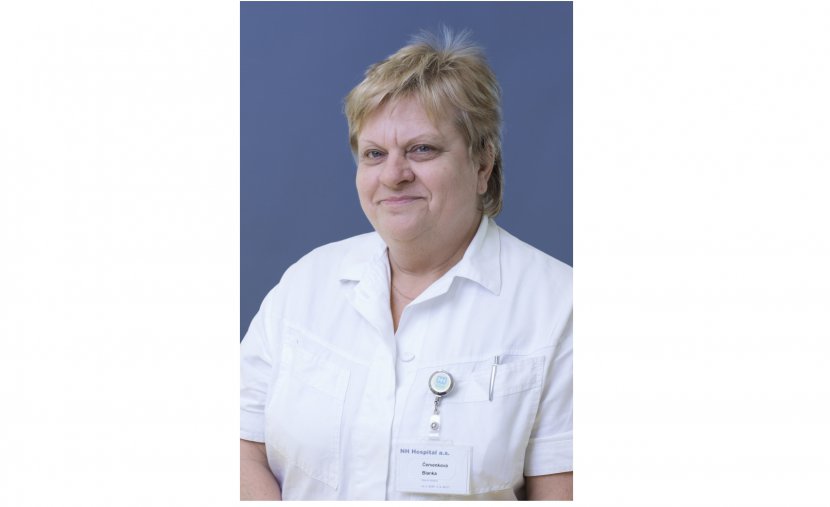
Blanka Červenková's whole life is mainly determined by her profession. When after finishing primary school she was not accepted for an apprenticeship as a hairdresser, because the socialist quotas did not allow it, she decided, thanks to her brother who was studying at the University of Mechanical Engineering in Pilsen, and also because of her good grades, to study at the Medical High School in Pilsen.
Did anyone influence you to choose midwifery?
When I wasn't accepted for hairdressing, I pouted that I wouldn't go to any school, but in the end I went to Pribram for two years of economics without a high school diploma, then I was supposed to start working, but my brother convinced me to continue my studies, so I chose the medical school and the fateful choice fell on midwifery.
Where did you go after your studies?
On 18 June, immediately after graduation, I joined the hospital, where I was assigned to surgery, then to the Lochovice circuit, and then to the gynaecology and obstetrics ward. I also got married, was on maternity leave twice, with the first son for 11 months, with the second for a year, and in the whole 40 years I only had about 5 sick days, otherwise I still go to work. The kids went to daycare and my parents helped out a lot too. First we lived in the apartment buildings near the hospital in Hořovice, then in an apartment in Višňovka, and then we built our own house, which we have lived in for 35 years.
How did your professional career continue?
I went through everything, the outpatient clinic, the gynaecology department, the six-week maternity ward, the delivery room, before the central operating theatres were built, so gynaecological operations were performed there.
You've probably seen a lot of chiefs...
Actually, I've seen them all. The first one was Dr. František Kolář, the first head nurse was Růžena Holmanová from Cerhovice, they were here when I started in 1975. I remember Mr. Kolář very much because he was a great personality. Next, for a while, it was chief Ivan Popilka, who unfortunately died soon, followed by chief Marta Martínková, and then chief Ales Klán. There was not much change in the chief nurses - after Mrs. Růžena Holmanová there was Mrs. Jana Jankovská and I was historically the third chief nurse and I was for 20 years, now I was replaced by Mrs. Pavla Fíkarová from Podluh.
Can you compare what obstetrics has gone through in those 40 years?
Midwifery has evolved enormously, an awful lot has changed. The biggest evolution has been the care of the baby, just the fact that there are mothers with babies in rooms now. We were one of the first maternity hospitals in the country to have babies with their mothers in the rooms, this was back in the days of the headmistress Dagmar Veškrnová from the neonatal ward. This was followed by the presence of the father at the birth, the attendants at the birth, the freedom of the women to decide what they wanted and what they did not want at the birth. Even the preparation for childbirth changed, I remember a time when a mother would come in to give birth and there was no way she wouldn't get an enema and be shaved.
Even the instrumentation has changed a lot. When I started in the maternity ward we only had ears and a stethoscope to listen to the baby in the tummy, now we have ultrasound, dopplers, we can hear the baby and mum can hear the baby with us. Moms are very informed. The materials used have also changed, nurses used to have to sterilise syringes, nowadays a lot of things are disposable. Even the work was different, there was a lot of technical work, for example, when gynaecological operations were over, you had to roll up the gloves, put the linen in the drum, sterilise everything, today's staff don't know that, but there are a lot of other things. For example, documentation has to be kept better, everything has to be documented. Nursing care today is no longer just about the doctor ordering something and the nurse fulfilling it and ticking it off. Today, the nurse herself decides on many things, and is even better trained than the doctor in some matters. Nurses have different special training.
So, obviously, the nurse can supplement and replace the doctor in many ways, who may no longer have this knowledge?
A doctor with his qualifications cannot be a nurse, he does not have her qualifications and vice versa.
The hospital has had a perinatology centre since last May, can you explain its mission?
We are one of the few maternity hospitals where women can give birth as early as the 32nd week of pregnancy; we are equipped with the personnel and equipment to do so. Previously, women could give birth here from the 36th week of pregnancy. At this week of pregnancy, the baby is already ready to enter life and we do not anticipate any significant assistance from us. Today, we have a chief doctor, Milena Dokoupilova, who came to us from the hospital at Apolinar, so we can take care of premature babies.
The neonatal ward takes care of the babies before they go home. The mothers after the birth are in the six-week ward, and the baby, if it is fine, is with the mother. However, if it is premature, it is in neonatology, where it is cared for by doctors and nurses with specialised training. We also have beautiful rooms in this ward for mothers to learn how to care for premature babies.
Obtaining the status of a perinatology centre is probably a great achievement for the hospital, when did the idea come about?
About 25 years ago, we realised that if a maternity hospital is to remain in a small town like Hořovice, and with a small catchment area - there was a maternity hospital in Beroun, there is one in Rokycany, in Příbram - it must have some chance of survival. We must therefore offer something more. And we decided to offer care for immature newborns. We started to promote this idea with Mr. Klán because mothers asked us what to do if the baby is not delivered. We told them that we would take them, that is the mother, before the birth or the baby after the birth, which was wrong because the mother stayed here and wanted to be with the baby and we wanted that too. Many of the paediatricians and nurses were angry with us, what are we making up, there will never be a big maternity hospital here, we are just a small town, only babies born here will always be delivered. But we said we wanted to try, so we tried, we packed up the births, we got staff. I remember the director at the time, Dr. Tomas Jedlicka, came to us, we had 400 births, and he told us that we would reconstruct the delivery rooms if we promised to have at least 600 births a year. We did. Then Mr. Chief Klan promised the midwives in the delivery room that if we reached 1,000 births per year, he would pay for their vacation in Egypt, and he kept his word.
Last year we crossed the 1500 births mark and this year the 35,000th baby was born here since the birth of the maternity ward, so I can see that our vision at the time was correct.
Of course, the growth has been gradual and has lasted 20 years. Today, perhaps few people realise that the demise of the maternity hospital in Beroun is not the fault of the new owner; it had already disappeared because there were few births there. The labour wards were reconstructed and modernised before privatisation and in the approach to mothers, so mothers started coming here and left the Beroun maternity hospital on their own. The Beroun maternity hospital was closing with about 200 births a year, and we already had the aforementioned 600 births.
What is the difference between being a head nurse in the gynaecology department and now being the head nurse of the whole hospital?
Now I am responsible for about 300 nurses, all specialties. In the gynaecology and obstetrics department it was a matter of one department, and there were about 40 nurses, and I decided who would go on which shift, where the nursing care would be directed, in my case in gynaecology and obstetrics. Now this is the job of the head nurses of each department. Of course, as the head nurse, I cannot even cover all the disciplines perfectly, I work with the head nurses and it's about setting up nursing care according to what patients are being treated where, so that there are enough qualified staff, I decide what staff we are going to recruit, who we are going to send to school, what kind of expertise the hospital needs. For example, with the creation of the neonatology and chronic and resuscitation care for children (OCHRIP) unit, we had to send physiotherapists for special training and internships to work with premature babies or with children in OCHRIP.
All wards have been renovated thanks to the new owner, now the 2nd half of the surgical ward will be moving. Understandably, the maternity ward has attracted a lot of people, but there is a new chronic care ward that has been open for a year, for example, for children whose fate has not been kind to them. There is a specialty in surgery for the treatment of inflammatory bowel disease. There always has to be a specialty that stands out that brings in new patients. The owner is investing heavily in all departments, now for example in the clinical laboratories. So we're not a provincial hospital with standard care.
Are you short of nurses in some departments? Where do they come from? Is there any interest in going to medical school?
We have the most contacts at the secondary medical school in Beroun, the owner even provides some students with a scholarship who can then join us. However, for example, out of the entire graduating class of 17 students, only three go to work, one to us, two to Prague and the rest go on to further studies. The lowest level of study today is medical assistant, graduates have limited competencies compared to registered nurses. For example, a medical assistant is not allowed to inject drugs into a vein alone. Today, a nurse must complete a bachelor's degree to be a nurse without professional supervision and apply for registration.
The market consumed nurses who knew the language, so they went to work in tourism offices, went abroad, etc. There is often talk about what the patient is entitled to, but little talk about what the medical staff is entitled to.
We get nurses coming in, then they get pregnant, it's always in some sort of wave, so three leave a ward at a time, for example to date we could easily take on 6 nurses, but it's never so acute that we have to close a ward. Previously, nurses used to flee to Prague because of the higher salaries, but today we are much closer to Prague with the salaries.
Nurses are not only leaving and returning, but you also have record-breakers who have been in the hospital for more years than you?
We have two record holders, Mrs Janička Srpová, who has been here 49 years and works in the internal ward, and Mrs Anička Zpěváková has been at the hospital 48 years and works in the gynaecology department. and in the outpatient department in Hostomice. Then there are several nurses 40 years old like me, for example Mrs. Drahuška Mráčková in the ARO, Mrs. Marcela Nešverová - social nurse, laboratory assistant Maruška Kreisingerová etc. Although some of them are already retired, they enjoy their work and do not want to sit at home.
Do you have time for hobbies with your demanding work?
I have two hobbies, one is my two grandsons, the elder Tadeášek is eight years old, the younger Matýsk is three years old. My husband and I have raised two sons, he has helped me a lot, today he has been taking care of the younger grandson for six months, because the bride started to work. She's doing very well. Another hobby of mine is photography, of course I mostly take pictures of my grandchildren, but I also like to take pictures of the sunset at the castle in Zabrze, a spider web with dew, or a long-toothed cricket flying on the geraniums in the evening. Such things make me happy. I took photos of both grandchildren until they were one and kept a journal to go with them.
Your wish for the readers?
It's the holiday season, so I wish everyone a good holiday. Our hospital, if possible, to use mainly for preventive care, in which it specialises a lot. And if they do have to get treatment, I want them to leave us happy and knowing that we helped them solve their health problem and that we are there for them and they can contact us anytime.
Marta ŠeVac