Česky
Česky


After all these years, does it ever happen to you that a case moves you?
Always. We do it to be touched sometimes.
Can you think of a particular situation?
You know, it's all about the great patience that some mothers have and some mothers don't. It's also about having to communicate with them and explain to them to give the kids time because they're not strictly set up to do what we or the parents want. It doesn't work that way even then in adolescence and certainly not with these little ones. Premature babies have to mature to figure out how to eat or how to breathe on their own.
Mothers who have been around a long time are running out of patience, often thinking the babies will eat and go home right away. Their only goal is to get out of here. They never trust us, they always think that the children will never thrive and will probably be here forever.
So it's more touching when I see them in the emergency room and they remember and say, "You got an impatient mommy upstairs again?" Cause it's over and over again. Then, of course, I'm moved by the more serious cases that turn out well and the parents come to show you the baby, healthy and happy. We've also had triplets coming to see us regularly, it's a wonderful feeling.
I guess it depends on the person's attitude in life as well. If he approaches everything positively, he probably copes better with being on the ward.
Exactly. We can talk to them up and down and many women must think we're saying the same thing over and over again, but it's really about nothing but patience. You can't make kids grow up fast and learn everything. Some of them are faster, some of them are slower.
One of the mothers came to see you before our interview with her son Sebastian. You mentioned they'd been in the ward a long time. How was he?
He was premature and had severe sepsis, an inflammatory reaction in his body. His mom was very patient and positive. If you stay here for even two months, you and the nurses and doctors become a big family. When she left, she texted us in the evening saying she was sad and missed us.
You studied at the secondary medical school and then joined the paediatric surgical clinic in Motol as a paediatric nurse. Did you know you wanted to work with children when you were studying?
Definitely, because I studied paediatric nursing.
How did you get into neonatology?
I moved from Motol to the Prague maternity hospital U Apolináře. They always said that you can't get nurses in the neonatal ward, that they all keep their jobs there because it's a beautiful job. But I've never been with immature babies and I never thought I'd end up there. It was a complete coincidence when a friend and I found an advert that they were looking for nurses at Apollinaris and gave it a try. I was hooked and I stuck with it.
Wasn't it more challenging for you? It must have been a difference working with different ages of children and having only newborns to care for at the same time.
Yes, but then again, anything new is interesting to me and I love to learn. It's always a new job, I learn something every day. Although Hořovice is a small hospital, I have encountered cases here that I have not experienced elsewhere. Neonatology is not only about immature newborns, it is also about healthy premature newborns, but they may have birth defects or diseases that one sees once in a lifetime, or not at all.
How many small newborns do you care for on the ward?
Here, we care for babies from 31 weeks of pregnancy, physiological newborns or premature newborns with postnatal adaptation disorder. In the big centres, such as the one I worked in at Apollinaris, the babies are from 24 weeks of pregnancy, so the babies are much smaller. The work there is more challenging, often involving premature babies of mothers who couldn't have come to any other state and are begging the doctors to save them at all costs, even though the babies are often less than half a kilo.
Have you experienced a case where a premature baby died?
You know she has. We recently had a baby die with a congenital developmental defect incompatible with life.
How are you dealing with that?
It's hard. I used to bemoan it, but I guess as you get older, you have to tell yourself that it was better for the baby, that at least he doesn't worry when his prognosis isn't good. It also depends on how long the child has been in the ward, if you know the parents maybe you are more immersed in the situation.
What about a case where the child didn't have a good prognosis but managed to pull through?
We had a little boy who was delivered but had a severe infection. Of course, I have to say that children who are quite resilient, if they get the treatment and care that they are supposed to get in a given case, they will, in the vast majority of cases, pull through. Even though he wasn't doing well at all, he was fully breastfed by day six and is now a perfectly healthy boy.
Could you compare that to 15 years ago? Would he have had a chance of a cure then?
Babies used to be more invasively ventilated and treated, now newborn care is less invasive. Medicine and procedures are advancing tremendously, and I think that especially in neonatology, it's different than it was twenty years ago.
You talked about the lack of nurses on the ward. Are they missing because there are not enough of them in general, or are they not flocking to neonatology as much?
I don't think young nurses are very familiar with the field. I taught for a year in a secondary medical school and the medical assistant course taught in medical school is a course that focuses mainly on adult patients, and the students have very little practice on children's wards. They don't go to the newborns at all for practice. Fortunately, this is changing in the universities, and from there they are already coming to us for practice. But it seems to me that they are afraid of small children.
I wouldn't recommend home birth to my family.
What does your day at work look like?
For me, the work varies depending on whether I'm a head nurse or I'm with the children, where of course I have to take services as well. There is a shortage of nurses and we are also facing this problem here. I like going to the children, but it is more challenging in that I have to do my job. Often it is also difficult for the other nurse who is on duty with me because I have to deal with many other things and I have to take time away from the children, even though I try not to.
So I usually come in the morning and the duty from the night is handed over. All procedures and examinations should take place at a certain hour when nursing care is provided. We don't disturb the babies unnecessarily often because they need to sleep and be still to mature.
Do mothers stay in your ward immediately after giving birth?
As soon as a mother is discharged from the six-baby ward after giving birth, we take her to our ward and try to fully involve the mother in her baby's care as soon as possible. It is not a problem for us for the mother to be with her baby in her room all the time - with the monitor, with the incubator. Most of all, we want them to be together. Mothers are trained during the day in caring for the baby, in bathing, in breastfeeding. We also involve the father in the care of the babies. One dad was even hospitalised with us instead of the mom before the baby was discharged to home care.
What are the most common threats to premature babies?
If I take it up with us, as a common problem for babies from 31 weeks gestation onwards is that they may not have mature lungs and may then be on non-invasive ventilation. They can't maintain their body temperature, so they're in incubators and in warming beds. They have a weak sucking reflex so they can't drink as much, have no strength and are usually on gastric probes. As they gradually mature and gain strength, they learn to latch on to the breast and relieve themselves. The idea is that they eventually breathe on their own, keep their temperature up and eat. When the mother is now known to be at risk of premature birth, she is given corticosteroid treatment to help the baby's lungs mature.
Home births are also a hot topic. Do you have any experience of them? For example, has a baby been brought to your ward who was born at home and needed prompt medical attention?
I don't remember a case where it was born completely at home, but it happens that babies are born on the way. Anyway, I don't agree with home births and I wouldn't recommend them to my family. It is important to think that we cannot predict the health of the mother or the baby during the birth, nor can we predict whether something will happen during or after the birth.
How many babies are born in your hospital?
Around 120 to 150 babies a month.
Can you remember the smallest baby born here?
I think it was about 900 grams.
My kids say I like babies better than I like them.
Have you noticed whether Vietnamese, Roma or other national minorities living in the Czech Republic treat their newborns differently than Czechs?
A lot of Vietnamese people give birth here, sometimes Romani people do, and sometimes we see mixed couples where one of the parents is from England, for example. As far as the Vietnamese are concerned, they have their own special foods that their families bring them here, but as far as their attitude towards their children is concerned, I wouldn't say they behave differently than Czechs.
Do you have any "old friends" among the mothers who have given birth with you repeatedly?
I'm sure. Some mothers give birth to a premature baby, but most of them give birth to a second baby at term. Then they come to say hello.
When I was touring the ward, I noticed a big screen where you have three separate sections with names on them. What's that?
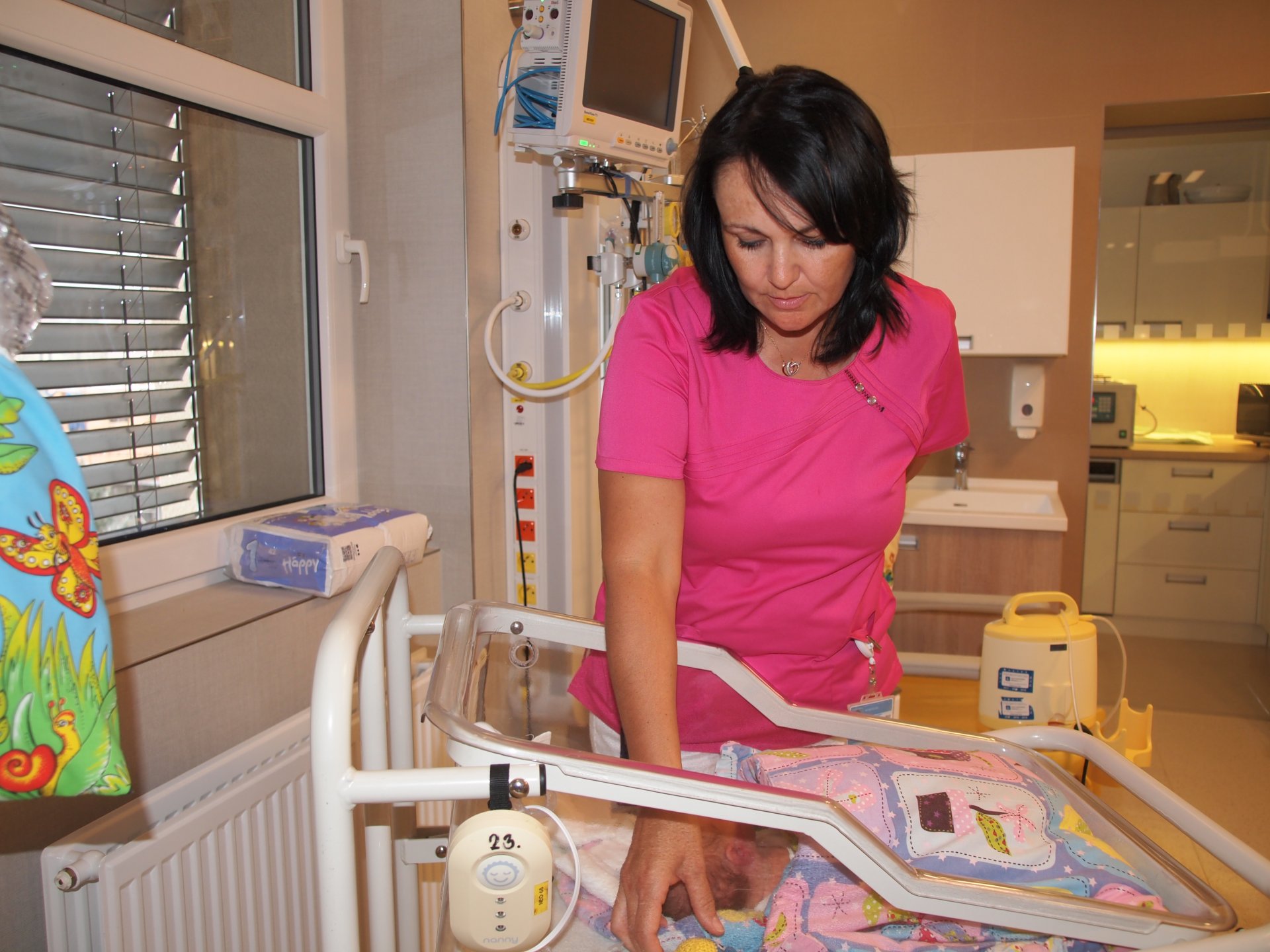
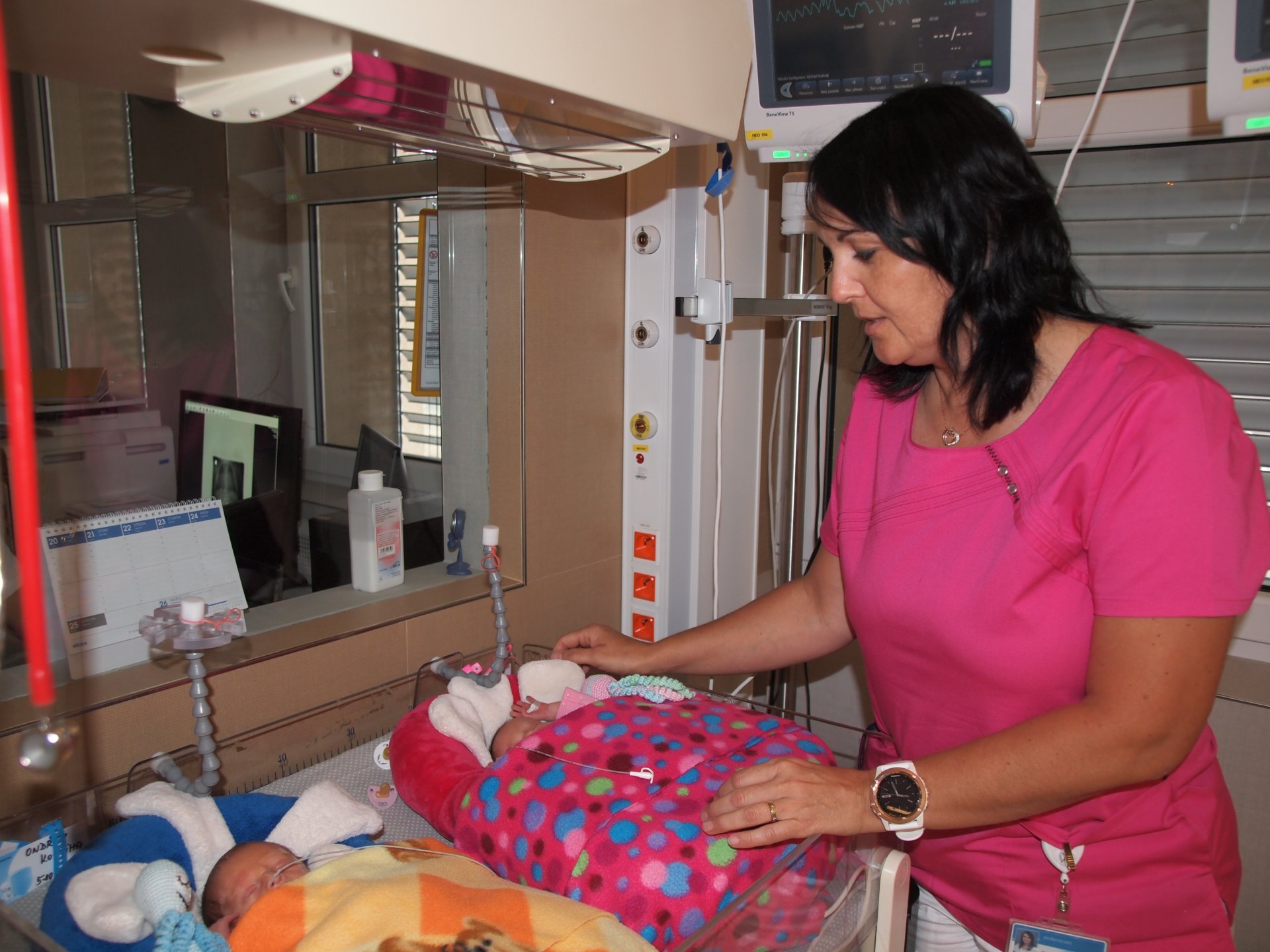
This is the central monitoring, the big screen that all the baby monitors are hooked up to. The central screen is divided into three sections where you monitor the left box, the right box of our ward and the mimics who are in the room with their mother.
We have two screens and they are set up so that they can be seen from all sides. It doesn't limit our work in any way and we can still see the monitor. There is a last name next to each monitor so we can see who has a problem and can run to them. That way the kids can be behind closed doors with mom and they are under her supervision as well as ours.
You don't have a problem remembering those names? After all, some mothers don't stay long on the ward and new ones keep coming in.
She does. When I'm preparing the outpatient clinic, I look at the names and I can't remember some of the mums at all. It's only when I open the ambulance door that I realise who they are. So sometimes it's a surprise to me who's behind the door.
Every job gets stereotypical after a while and sometimes you get tired. But does knowing that you are helping to bring new lives into the world and the gratitude of your relatives help you at times like this?
It makes me happy when mothers come back to us in the ward when they come from the outpatient clinic from Mrs. Dokoupilova, who runs a counselling centre for newborns at risk. It's lovely to see babies growing and developing before our eyes. The mothers come repeatedly to the ward, they do not miss the visit, they greet the nurses, they boast about how the children are growing...
How do you relax when you've had "enough" of babies?
I guess I never have enough babies. My kids say I like babies better than them. When I need to clear my head, golf with family and friends is a great way to relax. Then in the winter, I play badminton.
Kamila Prádová
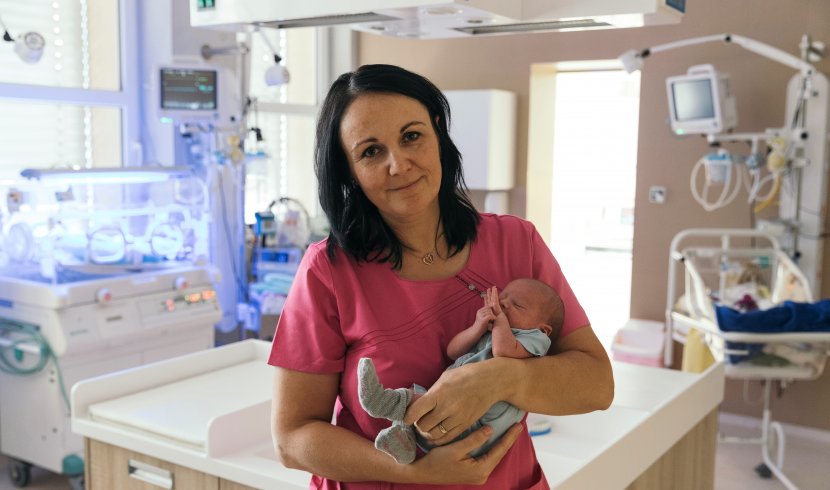
Born in 1972 in Hořovice. She graduated from the Secondary Medical School in Kladno, later she studied at the University of Health and Social Work of St. Elizabeth in Příbram. She started as a children's nurse at the University Hospital in Motol, then worked at the Na Homolce Hospital and at the gynaecological and obstetric clinic Apolinář. Since 2012, she has been the head nurse at the neonatology department at the hospital in Hořovice.
Alena Beníšková