Česky
Česky


Up to 2 million Czechs suffer from spontaneous urine leakage, especially women after childbirth. Faecal incontinence is less common, but all the more burdened with shame. It affects up to 15% of people over 70, but it does not avoid younger people either.
Incontinence restricts everyday activities - shopping, riding public transport, playing sport or socialising with friends. Many patients downplay their symptoms or are embarrassed to seek help. Yet early treatment greatly increases the chances of successfully managing the problem.
"The most successful treatment is the one that starts early. Each patient suits a different approach, so it is important not to wait but to solve the problem," says Julius Örhalmi, MD, PhD, FASCRS, MBA, specialist at Hospital Hořovice.
Permanent solution: sacral neuromodulation
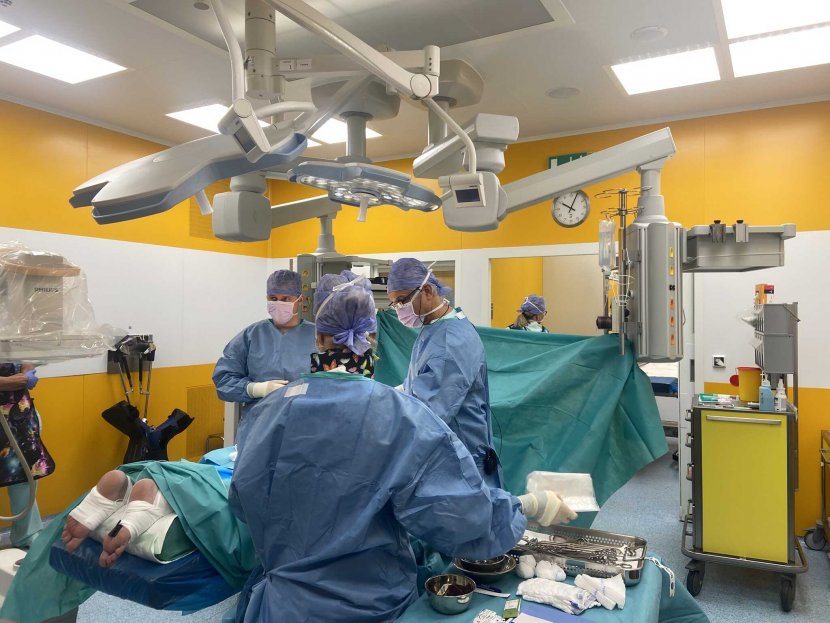
A modern, minimally invasive method in which a stimulator connected to electrodes is inserted under the skin in the buttock area helps restore the nerve connection between the brain and the pelvic floor. This helps control the urge to urinate and defecate.
The procedure is fully covered by insurance, is reversible and usually provides patients with significant relief or even complete resolution.
"The electrode is inserted first for a trial, followed by implantation of the permanent stimulator after two weeks if the effect is satisfactory," explains Örhalmi, MD.
As of June 2024, the new InterStim X stimulator, which lasts up to 15 years without recharging, is registered in the Czech Republic.
Patient stories: when the disease stops hiding
Mrs Beránková, who has been plagued by incontinence problems for almost 18 years after giving birth, is now setting up a patient organisation. Sacral neuromodulation gave me significant relief. I know what it's like to be in an information vacuum - that's why I want to help others."
Petra Kušková was troubled by spontaneous stool leakage after giving birth to her older son, who is now fifteen years old. A year ago, she underwent sacral neuromodulation at the hospital in Horovice. "I started walking to work again, I take the train. We go to the cinema, to the theatre and I am looking forward to seeing my son dance. I'm living a normal life again and I don't take it for granted."
Pavel Řeřicha, who has been plagued by repeated problems with haemorrhoids, adds: "The important thing is not to be ashamed and not to settle for a solution that limits you. Look for a path that allows you to live normally again."
Where to seek help?
So far, only five specialised centres in the Czech Republic treat faecal incontinence - Hospital Hořovice is one of them. Since 2018, more than 200 patients have undergone the procedure here.
All information and a questionnaire for those interested in treatment can be found on the website: www.bezomezeni.cz
As part of the World Continence Week, Hospital Hořovice has prepared consultation days for which patients can make an appointment and consult their problem with a specialist without prior recommendations or requests.
Consultation days: 17 and 18 June 2025 - it is necessary to make an appointment in advance by calling 311 555 000