Česky
Česky


Origins
The requirements and desire to build a hospital in Hořovice can be traced back to 1893. Already after the outbreak of the First World War in the autumn of 1914, a military infirmary was opened in Hořovice, located in the Sokolovna, with a capacity of up to 100 patients per bed. The head doctor was MUDr. Vilém Rissel. There were three other doctors from Horovice, MUDr. Levý, MUDr. Hnevkovský, MUDr. Hoffmeister. This infirmary functioned practically until the end of the First World War. After the end of the war, the Sokol members were able to return to the premises of the Sokol Hall.
In 1925, a large epidemic of typhus broke out in Hořovice. The source was water from a public fountain. About 60 people were taken to the hospital in Příbram. A sanitary column from Brno came to Hořovice and the dwellings of the citizens were disinfected. This epidemic promoted the acceleration of work on the town's public water supply system and strengthened efforts to build a hospital in Hořovice.
In 1929 a hospital was built in Beroun, this brought about the postponement of plans to build a district hospital in Hořovice.
After the end of the Second World War, however, these efforts were revived again. In the very first days after the liberation of the country, a committee for the establishment of a hospital was established. Until then, Hořovice had been dependent on district hospitals in Beroun and Příbram. A collection of money and various items needed for the hospital was organised in the town and in the surrounding area. The necessary staff was found and the hospital was temporarily located in the premises of the new castle. Furniture was procured from the apartments of German citizens. Within a few months, the collection raised a quarter of a million crowns.
The Board of Trustees of the hospital set salaries for the staff, for example the nurses were paid 700kcs, the cooks 600kcs per month. The medical service was provided by local doctors MUDr. Stýblo, MUDr. Kacerovský, MUDr. Špot, and MUDr. Růžička was the permanent doctor. The management and administration of the hospital was handed over by the town to the District National Committee, mainly for financial reasons.
Already in the middle of June 1945 the hospital rooms in the castle had to be vacated for the accommodation of the Red Army. Financial donations for the construction of the hospital kept coming from the surrounding villages, employees of the factories of the Hořovice district also contributed from their salaries, and collections were often organised, for example, a collection by the employees of the BUZULUK company is recorded. As of 20 October, the account already shows one and a quarter million crowns, with money coming from various parts of the country.
In 1952, the then chairman of the District National Committee of Hořovice drew up a resolution for the construction of a hospital, justifying the urgency of such a facility for the town of Hořovice and its surroundings. The argument is mainly based on the expensive transport of insured patients to other, more distant hospitals, the increase in population and industry in the area (especially the then enterprises BUZULUK, Harmonika). This resolution was sent not only to the Ministry of Health, but also, for example, to the parliamentary club. The land for the construction of the hospital has already been selected; it is the land confiscated by the municipality from the Schaumburg family, who were also the owners of the Hořovice castle and the fields adjacent to it. In the same year, a committee was appointed for the construction of the hospital, which already planned the gradual steps towards its construction.
In 1953, an investment plan for the construction of the hospital was approved by a decree of the Ministry of Health.
The following years were marked by preparations and building plans. A competition for the best project was announced. The designs of some projects have even survived and are stored in the State Archive in Beroun.
Laying the foundation stone
From the Chronicle of Hořovice, 1956:
"1956 was the year when the long-standing aspirations of the citizens of Hořovice and its surroundings were finally fulfilled and their long-standing wish became a reality: the construction of a district hospital began!"
From the newspaper Nová vesnice Hořovicka, No. 23, 1956:
"It started on Saturday (June 18)...It was shortly after seven o'clock in the evening when the first bus appeared on the square, from which the first dozens of citizens poured out. In a few moments there was a second, a third, and so it went on until eight o'clock, and from each there was a great crowd of people from all parts of the district, whose destination was the Castle Park. The weather was not in any way favourable to the organisers all the week, but at last it moderated to allow three thousand spectators to see Dvořák's "Rusalka." The stage of this performance was so perfectly prepared that the figure of the waterman from this opera really emerged from the water of the pond, which was then in the castle garden.
The next morning, visitors listened to a concert of two racing bands from the early hours of the morning... Also that day, buses from all over the district again converged to allow the participants in the celebration to take part in the historic moment of laying the foundation stone for the construction of the district hospital. There were again several thousand of them. This is best evidenced by the parade itself, which, when its front was at the castle building, the last rows were still in the square. Interestingly, the foundation stone itself came from the forest behind Hostomice. As a symbol of the joint effort, stones from other surrounding villages were also selected for the foundation. Many speeches were made at the laying of the foundation stone by representatives of the authorities and the ruling party, and the Deputy Minister of Health, Dr. Štich, stressed that the district hospital would be one of the most modern stands for health and that its health centre would be designed to prevent disease. One of the elderly ladies present then wished the hospital, "There is nothing left now but that the workers on that building should have plenty of strength and health for its early construction, that the wounded of some war should never be brought here, but rather that many healthy children should be born here, who will certainly have a more joyful life than we have had." It seems, with hindsight, that this elderly lady was perhaps the barrel-maiden who predicted the prosperity of the hospital, especially in the field of obstetrics.
Construction
By July of that year, construction of the hospital was well underway. In 1956 and 1957, a total of 7,316,000 CZK was built. At the same time as the construction of the hospital, the reconstruction of the house on the square (today's Hotel Zelený strom), which had collapsed due to earthquakes, was started. It is perhaps surprising today that both buildings were of almost equal importance in the chronicles of Hořovice!
In 1959, the part intended for the polyclinic was already completed. The only thing missing was a part of the electrical switchboards, which were a national staple at that time. The connecting road between the town and the hospital was also completed at that time.
On the night of 26-27 February 1959, a fire broke out at the hospital site. Unfortunately, the city's alarm siren was not working and the construction watchman could not summon help. In addition to the firefighters, paramedics assisted in fighting the fire, and an ambulance drove through town summoning help. The fire was started by an open gas burner and as a result the middle section of the roof burned.
On May 1, 1960, the citizens of Hořovice and the surrounding area gathered for a small celebration of the opening of the polyclinic in the new hospital. The director, MUDr. František Kabátník, took the oath on behalf of all the medical staff.
The opening ceremony of the hospital
In 1961, man entered space for the first time and on 9 July of the same year the hospital in Hořovice was inaugurated. On the eve of the opening, Hořovice celebrated the important day with a performance of Rossini's opera The Barber of Seville, which took place in the castle park. The opening was opened by the citizens of the town and the surrounding villages again with a festive procession that went from the square to the newly built hospital. Those attending had the opportunity to see the newly built hospital and the celebrations went on until late afternoon.
The opening of the hospital was extensively reported by the weekly Budovatel in its issue No. 28 of 14 July 1961, page 1: "The hundreds of people who came to the opening ceremony last Sunday did not hide their delight and admiration at the work which the state had built at a cost of many millions of crowns. Joy and tears...expressions of thanks. Like a fairy-tale castle with all its riches, a new and modern hospital (the most modern in the Central Bohemia Region - ed. Jindřich Vlasák) is standing here to bear its fruits in the near future: to protect and restore health to hundreds and thousands of workers in Hořovice."
Elsewhere in the article, the editor recalls, "Although the hospital looked quiet from the outside, inside it was full of bustle. The final touches before opening. Everything had to be dressed in white, washed and polished. And so we had no choice but to walk through almost the entire hospital - in our socks..." " ...Don't be angry, comrades," apologised Comrade Křepel, who was showing us around, "it was too much work to clean up, and then, after all, it's a hospital...!"
The inpatient part of the surgical ward was newly opened, and the operating theatres (one tiled with white tiles, the other with pale green) were prepared. Between the operating theatres was the sterilisation room. The children's inpatient ward on the ground floor of the hospital, the X-ray department and the kitchen and canteen for the staff were also ready for opening.
Further development, building
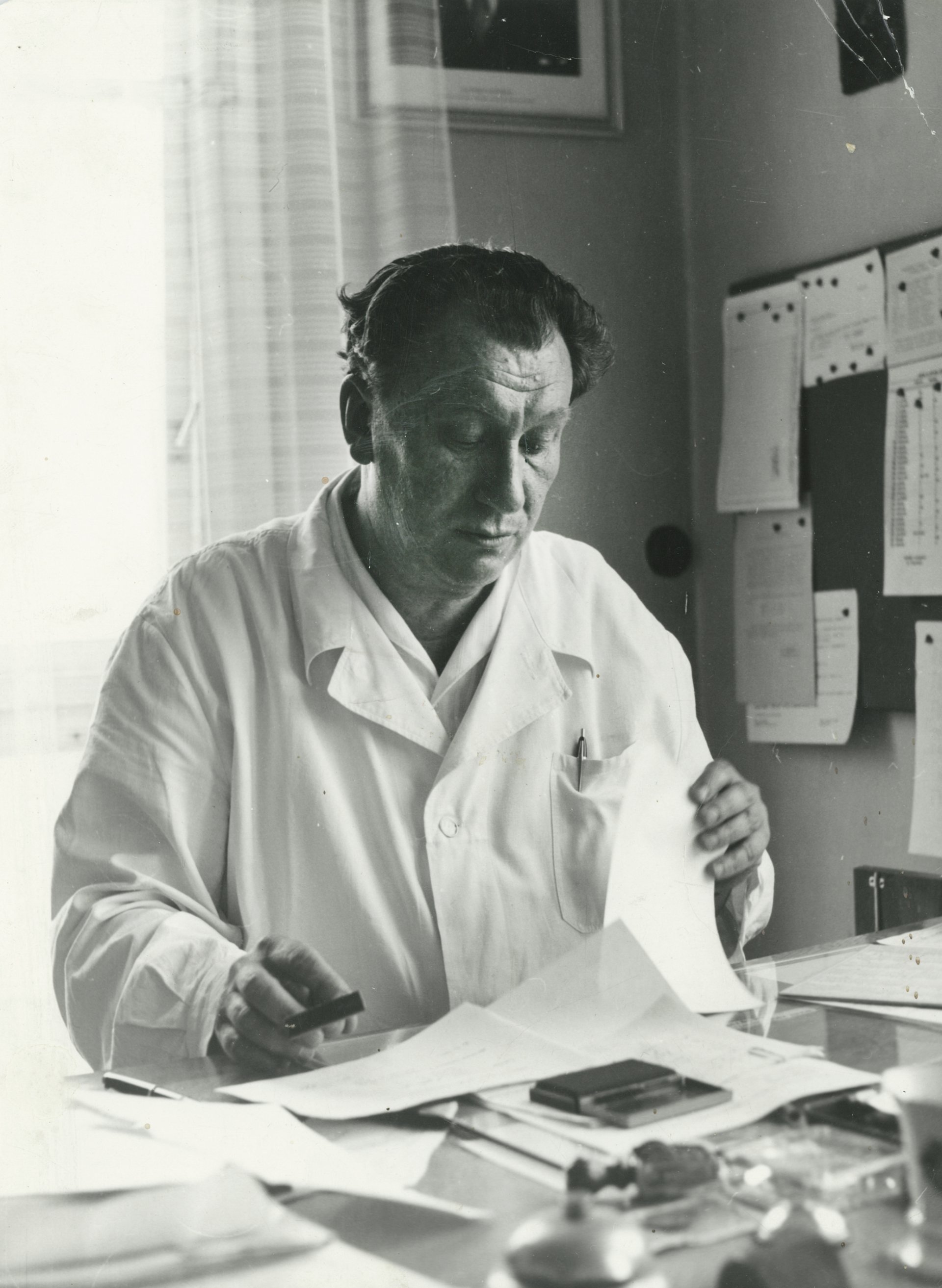
The first director of the hospital was MUDr. Kabátník, who led it for a short time after its opening.
The hospital in Hořovice was the first medical facility to be built in the Central Bohemian Region after the war.
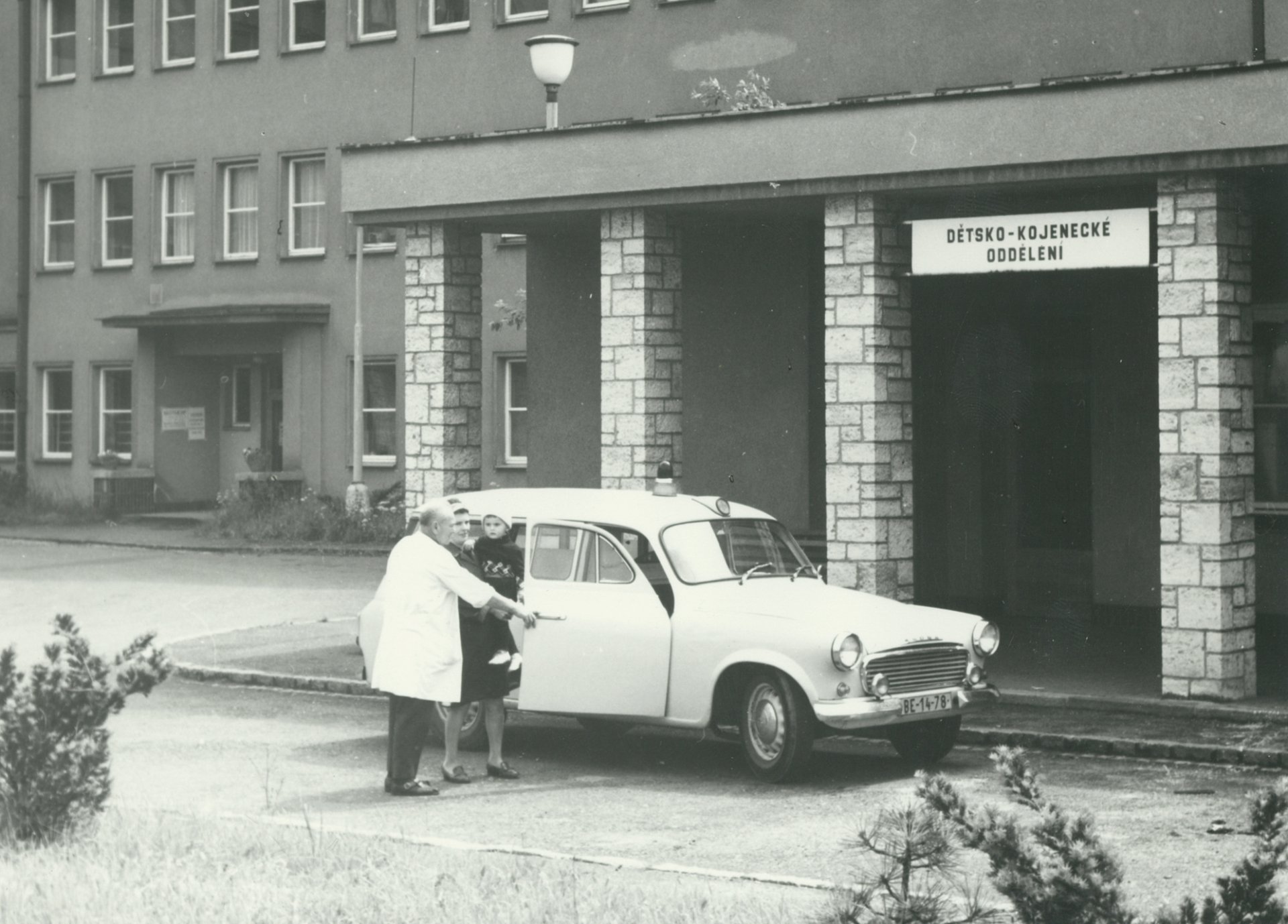
The operation of individual wards was started gradually due to the lack of doctors. First, the children's ward was opened, headed by Josef Linhart, M.D., followed by the opening of the internal medicine ward, then the surgical, X-ray and biochemistry wards.
The capacity of the hospital after the year of opening was 256 beds, 21 doctors and 95 paramedical staff worked there.
The gynaecological and obstetric (then female) department was opened in December 1961, and on 13 December 1961 the first baby was born in the maternity ward. Due to insufficient staffing of the ward, medical staff from the Prague Clinic U Apolinář arrived.
In 1962, an inpatient ENT department was opened. The first head of this then inpatient department was Miroslav Dusbaba, MD.
In the same year, a free room for the hospital staff was put into operation (originally it was a hostel for workers who were building the hospital). It was located in the place where the prefabricated houses adjacent to the hospital are today (above the NH premises), just off the road.
The individual wards were gradually staffed, which was not without minor or major complications. Significant complications are described, for example, in reports to the District Institute of National Health from the 1970s, where the hospital management complains of complications in ensuring stable staffing of the inpatient internal medicine ward.
Anaesthesiology was operated as a service under the Department of Surgery; the first inpatient anaesthesiologist was MUDr. Línková, then in the 1970s MUDr. Milada Ptáková, who after only one year of parental leave came to the hospital to put patients to sleep for operations. However, she remembers this time fondly today. When she returned in 1980 after her parental leave, the non-inpatient ARO department, which she headed as headmistress, was just starting up due to her intervention. In 1992, the ARO also began to function as an inpatient ward, and in 1993, under the leadership of prim. MUDr. Malý.
In the 1980s, the hospital management expressed concern about the lack of medical staff in the hospital, especially the lack of nurses, yet these problems were overcome. Several nurses and doctors were given priority apartments by the town of Hořovice, which were small in size but close to the hospital. Another advantage was the preferential placement of employees' children in nurseries and kindergartens.
In 1979, a central sterilisation room was set up, and two years later, in 1981, a room for mothers with children was created in the maternity ward of the hospital for the first time in the region, which was an unprecedented rarity at that time.
By 1988, the hospital offered services in 5 inpatient wards (gynaecological and obstetric, surgical, internal, ENT and paediatric).
In 1990 the hospital's heliport was built and approved (today there is an extension in its place, which houses the A&E and central operating theatres).
In 1991, the director of the hospital, MUDr. Tomáš Jedlička, took over the management of the hospital. Since 1992, the reconstruction of the hospital was gradually started.
In 1993, the inpatient Neurology Department started its operation.
Since 1993, the hospital has been gradually modernised. Gallbladder operations were newly performed using the laparoscopic method, the first room with superior care was created, which included its own shower, telephone and television. In 1999, the operating theatres were reconstructed, which brought, for example, the development of orthopaedic care.
In 2000, the hospital began construction of a new central sterilisation department, an X-ray department, an anaesthesiology and resuscitation department and operating theatre facilities. At the same time, in 2002, the reconstruction of gynaecology and labour wards was carried out and a new intervention room was built, which brought greater comfort to both medical staff and patients, who no longer had to be transported through the public corridor areas. A new heliport was built; the original one had to be cancelled due to the construction of an extension, which now houses the anaesthesiology and resuscitation department and the central operating theatres, and the radio-diagnostic department and CT scanner on the ground floor.
The present hospital headquarters building (the building next to the gatehouse) has also undergone an interesting development. In 1961, when the hospital was opened, there was only a porter's lodge and a refreshment kiosk. The hospital headquarters was located on the first floor of the polyclinic section (today it houses the outpatient section of the neurology department). It was not until 1979 that the present headquarters building was enlarged and extended to its almost present form (but still without a pharmacy). Since then, the headquarters have been located in these premises. The pharmacy was not built until 1993.
Perhaps a little amusingly, it was not until 2005 that the original civil defence shelter, which was located in the underground parts of the hospital, was rebuilt. Today, it houses the changing rooms, storage areas and archives of the hospital.
Instrumentation (e.g. CT scanner, X-ray and sonographers) has been gradually replaced. In 2007, a central patient reception was built. The pharmacy on the premises was renovated and additional outpatient clinics were added. In 2009, the neonatal ward was partially reconstructed and the sixth-grade ward underwent a complete reconstruction. In 2010, the oncology inpatient ward was fully operational, providing, among other things, chemotherapy.
In the period from 2010 to 2014, for example, the construction of new premises for the physiotherapy department was carried out. The internal medicine, paediatric, neurology, gynaecology and all outpatient departments were reconstructed and expanded. The existing operating theatres were reconstructed and a fourth operating theatre was built.
In 2014, further renovations continued and the construction of the fourth operating theatre was completed. As the first hospital in the country, a long-term intensive care unit with resuscitation for children was opened here.
In the autumn of the same year, the newly reconstructed neonatology department was granted the status of a Perinatology Centre. Also, a new machine was put into operation in the pulmonary outpatient department, which is used to examine the lungs. It allows, for example, to determine the diffusing capacity of the lungs.
In 2015, the construction of the left wing of the hospital was completed, which now houses the orthopaedics department on the ground floor, the inpatient neurology department on the first floor and the surgery department on the second floor. New premises on the ground floor of this wing were given to the clinical laboratories. At the beginning of 2016, construction was completed in the basement of the main hospital building, which houses a new staff canteen that also serves as a high-tech space for conferences and seminars.
Hospital Hořovice can now boast several unique features; in addition to the above, it also has the largest blood transfusion station for blood donors in the Central Bohemia Region with 11,000 donations per year and the largest maternity hospital in the Central Bohemia Region (excluding Prague) with 1,599 births in 2015.
The founders of the hospital
From its establishment until 1991, the hospital in Hořovice was under the District Institute of National Health in Beroun. After that, it was a contributory organisation until 2002, whose founder was the District Authority of Beroun. From 2003 to 2005, the founder was the Regional Authority of the Central Bohemia Region. From this year until mid-2007 the hospital was managed by the Regional Hospital Příbram, a.s. MUDr. Tomáš Jedlička is in charge of the management.
In June 2007 the hospital was privatised. Its owner since June 2007 is Ing. Sotirios Zavalianis, the hospital is operated by NH Hospital a.s.
NH directors:
MUDr. František Kabátník ????
MUDr. Jaroslav Vyhnal ????
MUDr. Jitka Davidová ???- 1987
MUDr. Josef Holmann 1987 - 1989
MUDr. Richard Valta 1989 - 1991
MUDr. Tomáš Jedlička 1991 - 2008
Ing. Pavel Staňa 2008 - 2012
MUDr. Luděk Pelikán 2012 - 2015
MUDr. Michal Průša from 2015
Heads of individual departments:
Department of Internal Medicine
MUDr. Hochman
MUDr. Teodor Hanák
MUDr. Donocik
MUDr. Jan Dušek (substituted by MUDr. Ivana Majorová)
MUDr. Marie Jelenová
MUDr. Pavol Brunclík
MUDr. Michal Šmíd
MUDr. Markéta Veverková
Department of Surgery
MUDr. Zdeněk Hlaváček (temporarily also MUDr. Berger, MUDr. Doubner)
MUDr. Miroslav Bejlek
MUDr. Ivan Major
MUDr. Jiří Plecitý
MUDr. Roman Vacek
MUDr. Richard Sequens
MUDr. Zuzana Šerclová
Department of Anaesthesiology and Resuscitation
MUDr. Milada Ptáková
MUDr. Roman Malý
MUDr. Michal Průša
MUDr. Jiří Steinbach
Children's Ward
MUDr. Josef Linhart
MUDr. Daniela Veškrnová
MUDr. Antonín Duchan
MUDr. Luděk Pelikán
MUDr. Zuzana Vančíková
MUDr. Vít Jakoubek
MUDr. Mahulena Mojžíšová
Rengen, SONO
MUDr. Hrdý
MUDr. Prstek
MUDr. Michaela Dušková
MUDr. Alexandra Švamberková - acting
MUDr. Vlastimil Prokop
MUDr. Kamil Sukovský
Rehabilitation Department
MUDr. Jaroslav Malenínský
MUDr. Jiřina Eichenmannová
ENT
MUDr. Dusbaba
MUDr. Jiří Mádle
Transfusion Department
MUDr. Marie Hlaváčková
MUDr. Zdeněk Malaska
MUDr. Irena Klánová
Gynaecology and Obstetrics Department
MUDr. František Kolář
MUDr. Ivan Popilka
MUDr. Marta Martínková
MUDr. Aleš Klán
MUDr. Vladimír Folauf, MUDr. Věra Pavlů
Department of Neurology
MUDr. Miroslava Sinkulová
MUDr. Martin Šrámek
MUDr. Stanislava Adámková
Neonatal Department
Historically part of the Children's Department - the department has been independent since 2008
MUDr. Zdeňka Sýkorová
MUDr. František Zahálka
since 2013 MUDr. Milena Dokoupilová
Orthopaedic Department
MUDr. Jaroslav Forman, st.
MUDr. Ladislav Vaněček
MUDr. Milan Pastucha
Department of Pathology
MUDr. Zrůstová
MUDr. Alexandr Švec
MUDr. Pavel Dundr, Ph.D.
Department of Paediatric Post-acute Intensive Care
MUDr. Daniel Blažek
Dental Department
MUDr. Jan Adamec
MUDr. Zdeněk Kaiser