Česky
Česky


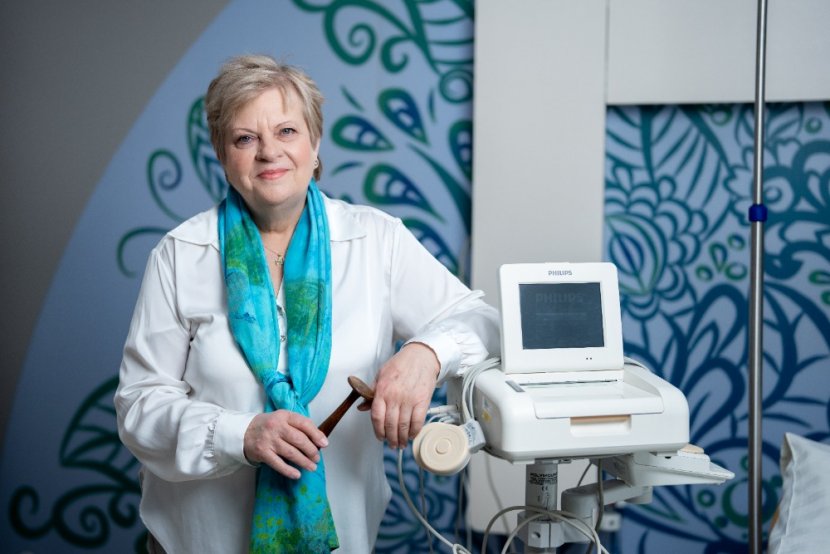
Mrs. Červenková, when you say "Hospital Hořovice", what is the first thing that comes to your mind?
My whole professional life comes to mind. I first came here in 1973 as a student on a work placement during the summer holidays. At that time I was studying at the medical school in Pilsen, preparing for a career as a midwife and "chasing births" for graduation, as it was called then. Actually, I was influenced by chance. I originally wanted to be a hairdresser, but they didn't take me. Out of spite, I went to a two-year business school, which I finished. Then I went on to a four-year midwifery course. My brother, who was studying in Pilsen, helped me, and he said, "If you're good at studying, why should you go to work right away?" And my aunt, who wanted to be a midwife, also supported me. So I tried the entrance exam - and it worked out.
And when you first came to practice, you were here in Hořovice in the hospital?
Yes, I did my internship here in Hořovice. Even during my studies in Pilsen, we had to have conducted forty deliveries independently to graduate, which was a lot. Some of them were done at school under the guidance of a teacher or a doctor, but others we had to arrange ourselves - it wasn't an internship like today, when it is arranged by the school. Everyone had to find their own way. We kept a notebook where we wrote down which births we had, who was present, and we also wrote in the birth book as students. And when I first came to the practice, I knew I had made the right choice. I admired the midwives who worked there and wondered if I could ever do it like they did.
Can you count backwards or at least estimate how many births you've been to?
I know of one colleague who wrote down every birth and kept count, but I never did. It's not in the counts.
Do you have a birth that sticks in your mind?
My very first birth, when I was a student. It was a surprise because there were no ultrasounds then. The lady gave birth very nicely, so the midwife asked me to deliver her. Then suddenly she started calling out that there was another one, and it was twins.
And when exactly did you enter the hospital in Horyovice?
June 18, 1975.
If you were to compare how the hospital looked at the time of your arrival and now, can you compare it at all?
It's hard to compare, a lot has changed. The population, the staffing requirements, and most importantly, the conditions. There used to be one nurse for every 35 patients, now we have support staff. There were no disposables, everything had to be sterilised - syringes, catheters. We didn't have central sterilisation, everything was done on the ward. Operations were done in smaller theatres, and even on night services they sterilised. Now we are more patient-oriented because modern times demand it. Earlier, after surgery, a patient used to stay in gynaecology for 10 days, now it is 3-4 days at most. Also, the number of deliveries has changed, initially we had two maternity hospitals in the district, then we merged into one. The reconstruction of the delivery rooms was already underway before 2007, when Mr Zavalianis bought the hospital. We wanted to have a better quality environment and neonatal services. This led to us starting to build a neonatology unit for babies with lower birth weights. Gradually, the hospital has reached the level of a perinatology centre, which is a great progress.
If you were to compare that previous generation and the current generation of health professionals, is there a difference? Are they the same?
As the world changes, so do we. But one thing remains - whoever wants to work in healthcare must have empathy. You can't do it without it, and it has always been true. Whether it's caring for mothers, children or patients in general, concern and humanity are essential. The question of whether one can handle the responsibility - mentally and physically - is also important. It is not an easy job, and it never has been. Despite all the modern technology and robotic surgery, the most important thing is still the person who uses it - a person who is educated, skilled and has his or her heart in the right place. For non-medical professions, the most important thing is patient care - human touch, empathy and a sense of security. There is no substitute for technology. The patient needs to know that when they need something, someone is there for them.
What do you consider your greatest professional achievement?
Probably the fact that I accepted the challenge of becoming Deputy Director of Nursing when I was a year and a half away from retirement. Not everyone gets that chance in life, and I'm glad I took it. I think it was meant to be. I totally don't understand people who come into a position that they're looking forward to and they're there for two days and they find out they're not going to do it. Every time I've accepted a task, I've tried to tackle it. There are several paths to the goal and it's too early to give up when you step on one and find it complicated. It's a shame to give up on that first path. When I started, there were 400 of us; today there are almost 1200. As the hospital grew, so did new challenges - staff shortages, organisation of operations, introduction of new technologies. As a deputy, I was more focused on care development and quality; the head nurse provided the staff. Today we have specialised positions, we train our own paramedics, and scheduling operations is faster and more flexible. Care has transformed - everything is changing much faster today than it used to. Slowly but surely, new professions are establishing themselves in healthcare, which helps us especially in organisation and management.
Do you have a successor?
Yes. Of course. A good leader is one who does his job and prepares his successor. And those who don't are not doing their job. It's also important so that if something happens, one of his people can take over. They don't have to know everything, but at least 50% of their supervisor's work. He may already be working and filling in the rest. I started training my successor right away as head nurse of the gynaecology and obstetrics department. She was the current head nurse Pavla Fíkarová. I also passed on my experience to the current head nurse, Adela Šubertová, as head nurse of the hospital and deputy for nursing care. I think we chose well. Many things will naturally change, the hospital in Hořovice will continue to evolve, and so it's okay.
And do you have someone in your family who will take over the imaginary baton in the healthcare system?
I'm sorry, but no one in my family is going into the health care system. My sons have chosen another field, we don't have any granddaughters, and my grandsons are still young - one is 18 and in high school, the other is 12, so we'll see.
Can you relax at home when you're not at work?
I think I can relax. All I have to do is look outside and the sun is shining. I used to have two cameras and take a lot of pictures. When my kids were little and then when my grandkids were little. Now I only take pictures with my cell phone. I like the little things that delight and enrich - like drawing frost on glass.
Did you have or do you have a hobby?
Photography. And then we have a garden that requires a lot of work - that's more of a horse than a hobby. For my husband's 60th birthday, I got 60 rose bushes that I take care of. My husband, on the other hand, is more into tomatoes and peppers. I like to travel - both to the seaside and here in our country. We recently enjoyed a weekend tour of Hluboka. This March, my husband and I had the dream of a lifetime - we spent two wonderful weeks in Cuba. The vacation I received from the owner of the medical holding company, Mr. Sotirios Zavalianis, was for my life and work anniversary. It was an unexpected surprise and we are very grateful for it.
I am glad that I could be part of a team that materialises the vision of accessible health care focused on human health, provided by professionals with humanity and friendliness. These are values that make sense - in every era.