Česky
Česky


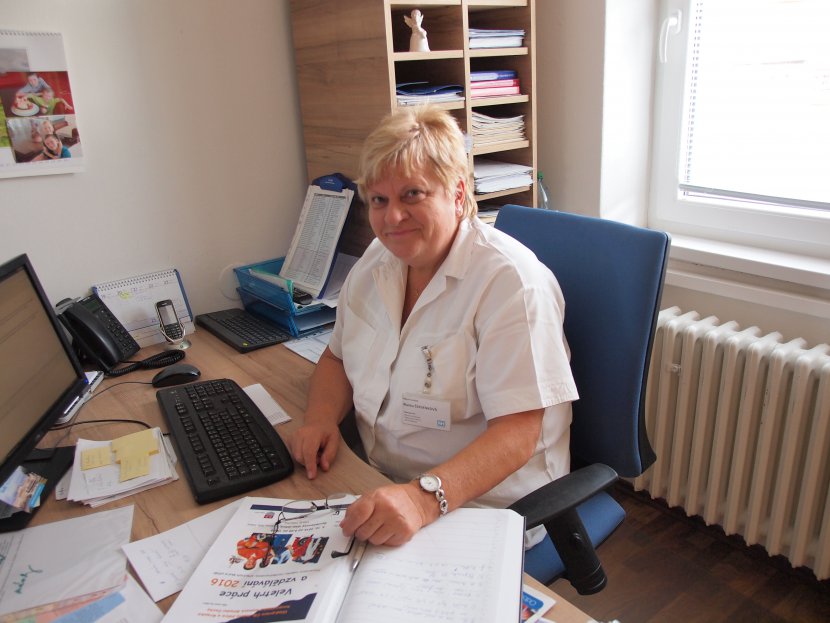
What brought you to healthcare?
Actually, it was my brother and my aunt. I did well in school, but I got it into my head that I wanted to be a hairdresser. I didn't get into hairdressing because of the quotas that were allocated for different professions at that time. So I graduated from a two-year school of economics, and because I was a good student, my brother, who was studying at a university in Pilsen at the time, convinced me to continue my studies somewhere. My aunt again told me how she once had to go to study to be a cook because she was not accepted to study to be a midwife. I was shaking my head until I thought I would try to apply for this course. And it worked. So I started studying at the secondary medical school in Pilsen, majoring in midwifery.
Do you remember your beginnings?
During my studies, I used to come here, to the hospital in Hořovice, for voluntary practice. I worked with the nurses in the delivery room for a good part of the holidays. I was terribly taken with the work. After graduating from high school, I started working here in the gynaecology and obstetrics ward with the mothers in the sixth-grade ward. The first week I went to morning with a senior colleague. After a week, the head nurse came in and said: Hey, you're pretty smart, you're going to the service. I gradually worked in the sixth-grade ward, in gynaecology, in the delivery room...
If you compare, which job do you enjoy more?
Until three years ago I was head nurse in the gynaecology and obstetrics department, so I know that with a management position there is more administrative work at the expense of professional work. So the transition from head nurse to head nurse was easier for me. Trying something new motivated me a bit to take up the challenge and try the head nurse position even at that more mature age.
The hospital has two accreditations: ISO and SAK...
When we were deciding how to move the hospital forward qualitatively, we considered the accreditation awarded by the Joint Commission on Accreditation (JCA), but we were concerned that we didn't qualify. So we tried to go through ISO accreditation, which is awarded by the Czech Institute for Accreditation and is a bit easier. If we make it, we will refine the system and try SAK. Everything turned out well. We have already defended ISO for the third time, and we will defend SAK for the first time next year, three years after we got it.
You are known to have a very friendly maternity ward.
There is a lot of interest in our maternity hospital. Hořovice has 7000 inhabitants and more than 1500 mothers give birth here every year. If the situation continues as it has been, this year we are on track for up to 1,700 births. In August alone, 162 women gave birth here, which is a real success.
But what preceded this success?
First and foremost, it was years of building up the maternity ward. After the revolution, we considered what to do with our provincial maternity hospital with about 400 births a year, how to improve it and make it more attractive. Even before 1989, thanks to the head of the neonatal department, we were able to make it more attractive. MUDr. Veškrnová was one of the first to introduce the rooming-in system. It was clear to us that we had to conceptualise births and the maternity ward differently than was common at that time. The midwives discussed all aspects with the doctors, and we were among the first maternity hospitals where the father was allowed to accompany the baby. Even under the director, MUDr. Jedlicka, we started to renovate the delivery rooms to make them more comfortable and make mothers feel more at home. But most important of all is the attitude of the staff, although of course the environment plays a role too. It is thanks to the nice environment and friendly staff that women want to give birth with us. We tell every new employee that we want our mothers to be happy in the maternity hospital. If a staff member doesn't understand this, we have to make it clear to them that it will not be possible for them to work here. We're all about quality care. The owner of the hospital Ing. Zavalianis has also invested considerable financial resources in the development of the sixth- and neonatology department.
Your maternity hospital has had the status of a perinatology centre since 2014...
Yes, you could say another stage on the road to improvement. One of the reasons for building the centre was the frequent questions from mothers of premature babies who had to be transferred to other units: Where is my baby, why can't I be with him? We understood that separation from the baby was not good for the new mother or the baby. We thought about how to arrange it so that immature babies could stay with their mothers here. The only way was to get closer to the mothers with the care of this newborn so we wouldn't have to take the babies away from them. The journey was quite challenging and after the arrival of MUDr. Dokoupilová, Chief of Neonatology, and the joint cooperation with the Gynaecology and Obstetrics Department, headed by MUDr. Klán, Chief of Obstetrics, we managed to build a perinatology centre. Today we are able to take good care of immature babies, so that women can give birth with us from the 32nd week of pregnancy.
The dynamic development of the hospital is also evidenced by the fact that two years ago you opened a ward for children requiring chronic resuscitation and intensive care.
We believe that we were the very first hospital in the country to build such a ward. There are a lot of children requiring chronic resuscitation and intensive care and they need it for various reasons. Normally, these children are treated in the paediatric ICU. Our ward, under the leadership of the head of the department, MUDr. Blažek, provides a more child-friendly environment. They can be visited by their family, practically without restrictions, and we try to make their lives a little better, since fate has been so cruel to them. We plan to expand the ward.
You also specialise in the surgical management of Crohn's disease.
The incidence of Crohn's disease is increasing, unfortunately often in young people who often come to us in a serious condition where previous treatments have failed for a long time. We try to help them with surgical treatment. I have to say that we have good results thanks to our chief surgeon, MUDr. Šerclová, who, together with MUDr. Sequens, is the main surgeon for this disease.
What else can your hospital boast of?
In the summer we started building a company nursery, which will certainly be welcomed by all employees. It will have 28 places and we will naturally adapt its schedule to the time needs of the employees. We are currently inviting applications for a kindergarten teacher. We have also received a grant for palliative care and will be rolling out palliative care for adults and children. The expert guarantor is the head of the children's ward, MUDr.Mojžíšová. In the meantime, we will be doing a lot of training and learning in this field wherever they have experience with palliative care. To begin with, we would like to set up a room in the internal medicine ward that would be used for the patient and the family to spend as much time as possible there.
Do you feel a shortage of nurses?
I don't know of a hospital that can say it has all the nursing positions filled. We have students from the Secondary School of Nursing in Beroun. Some of them come here because they know the hospital and like it. We try to work a lot with the nurses. If we can, we accommodate them with part-time jobs. We support their further education by modifying the services so that they can go on to school. The owner invests a lot in the education of all the staff, and pays for nurses studying in college every other semester.
Do you provide any other benefits to the staff?
We provide a pension contribution, which is three per cent of the employee's gross salary. The more time a person works for the hospital, for example by taking the shift for absent staff, the more his salary increases and therefore the amount of the contribution. We also have a contract with a pension in Špindlerův Mlýn and Šumava, where our employees can stay for a relatively decent price. This year, for the third time, the owner of the hospital has sent 15 employees, whether they are cooks, orderlies or doctors, on holiday to Greece. For the first time, the trip was given to long-time good workers. Today, the workplaces themselves can anonymously determine who deserves the voucher through a survey. The trip includes a voucher for a family member, so it is a very nice benefit.
Do your nurses also go abroad?
I haven't encountered one in the last three years. But, of course, nurses sometimes leave because they get married, change their residence, the reasons are different, sometimes financial. Or if you commute and get a good offer in your place of residence, there is nothing to solve. A certain number of departures are natural and cannot be prevented.
An amendment to Act No 96/2004 Coll. is under discussion. What is your opinion on the proposed form of nurse education? Will it solve the shortage of nurses?
I think that the amendment will not completely solve the shortage of nurses, but the more qualified the staff, the better. However, I am not entirely convinced that there must be equally qualified staff in all positions. In my experience, I remember nurses who applied to a four-year medical school but, like me, got A's or B's on their report cards. We took entrance exams in Czech, math, biology and an oral interview. It was a crucial selection that not everyone passed. Nowadays, girls and boys with Bs apply to the school.
There are voices saying that the present form of the secondary school is not up to the required standard, that there are too many general subjects at the expense of vocational subjects...
During my studies, all the vocational subjects were taught by doctors who also examined us. The exception was a midwife with many years of experience in the hospital. The teaching was more practice-oriented. If the forthcoming amendment goes through the legislative process, the question is what kind of content will be given to this education. What will change in the teaching at the Nursing School, what the content of the curriculum for nurses will be in each year, who will teach there, whether it will be people from practice who can explain the issues and demonstrate them with examples. I still remember the cases related to teaching that the doctors told us about in class, and later in practice it was very useful for me to know about them.It was not dry theory, but also interesting case studies from practice that I will remember until the day I die. But not only on this depends what future nurses will be like. You can't say: it was good then and it's bad now. But it is necessary to prepare the curriculum so that nurses are well prepared for practice.
What about administration?
Recently, we have been trying to transfer all the activities that burden the nurses and that go to other staff. We have set up clerical workers in all the units to prepare medical records for archiving, deal with insurance companies for various documents, order medical supplies and keep track of stocks, and organise the provision of regular inspections of equipment and repairs. These jobs were previously done by head and station nurses. However, we want the most qualified nurses to be with patients and staff as much as possible, so as not to burden them unnecessarily with administration. From next year, we are also planning to delegate the training of staff to a subject matter expert, such as occupational safety training, fire protection, information technology, waste segregation, etc., so that the head and station nurse have time to train them in specialist issues. I think we are succeeding in doing that. In the beginning, some head nurses were fundamentally against administrative staff, but now they are happy. In the surgical ward we had one administrative worker for two stations. Now we have had to recruit a second one, and we are gradually identifying other activities arising from the operation that can be delegated to them.
What's the best thing about your job?
I'm always delighted when young nurses come into the hospital and manage to educate and stabilise them so that in time they can replace the older ones. Or when we open a new department, like OCHRIP, which nobody had, that we've managed to get people who can do that. It's also very nice when a doctor from orthopaedics comes to me and says: Mrs. Chief, imagine, our girls really scored, they managed to successfully resuscitate a while ago, they are very skilful. I felt a chill of joy all over my body, so I went and bought them a cake. Little things that make you happy. Someone might grumble about all the certifications, but the girls clearly know what to do, they have the correct description of the equipment, they know where it is stored, everyone knows where to reach. And all this contributes to the uniform order in the hospital. I am pleased with the dynamics of the hospital. I know from experience that it is important for a good team that all ages are represented. I am convinced that each age group is specific and has something to offer. With too young a team, there are problems in keeping the wards running. They all have young children... If there are more mature staff, it creates a reserve that can hold the department together if necessary. And vice versa, when new things come along, like electronic documentation, the older ones usually say: what are you going to do to us again. But the young ones will say: don't worry, we'll get it done and they'll just manage. A collective made up of different ages is constantly shaping each other without realising it.
Do you have any method of getting the staff to harmonise properly?
It took us a few years before we could say that more than 90 percent of the people are able to understand and accept this system. We have a complaints institute where patients can also write complaints about staff behaviour. I have to say, and I am very happy about this, that there are very few complaints about nurses. People have to be worked with. Three years ago, a nurse-assistant came in crying that she could not cope with the work. We made shifts in responsibilities, services and so on and today she is happy, satisfied, working very well and will be defending her bachelor's degree. When someone comes in after school, I always tell the supervisors that there is nothing easier than to let them know they can't do anything, are stupid and inept. Disable him and cut him off from work. He'll probably leave disgusted and maybe even out of the business. But to take him in, teach him something and make him a good worker is a fine art. You have to look and consider what he is good at and build on that and shape him. Cut like a diamond. You have to help him find the right place, even in a different workplace, but to make the work fit him and make him enjoy it. A team is like an orchestra. If it's well matched, the results will match.
Markéta Mikšová