Česky
Česky


Which orthopaedic problems do patients of Hospital Hořovice most often come with?
Patients visit us with common problems, their spectrum will be the same in all hospitals in the country and in all common orthopaedic outpatient clinics. Due to civilisation diseases, overloading of the cervical and lumbar spine is frequent, from which I insult shoulder and elbow pain, then lower back pain. Fresh injuries or post-traumatic complications on the musculoskeletal system are an integral part of this, in winter it is frequent injuries from skiing, in summer on the other hand, injuries are related to long days and thus a higher chance of an injury such as gardening or a fall on a bicycle. Another important segment of our work is arthritis problems of the large joints and then of course all the follow-up surgeries, both elective and acute. The orthopaedic outpatient clinics are very busy, with a typical appointment time of around 6 weeks.
The orthopaedic equipment in your hospital is of a high standard. Does this mean that you are able to solve all your patients' problems surgically?
Of course not, all difficulties can only be solved surgically in highly specialised teaching hospitals or trauma centres. We will never get to polytrauma, and I think that is correct, because specific problems need specific solutions and it is not within the power of small hospitals to cover the problem.
What role does the age of the patient play in a challenging major joint replacement?
You could say that it is not the physical age that plays a role, i.e. how old a person really is, but rather the biological age, how young they feel and how young and well preserved their other systems are, especially their cardiovascular systems. Age is not a barrier, I have operated electively on people over 95 for joint replacement. We've operated on people over 100 for trauma. There was no other option. If the benefit outweighs the risk, we operate.
How long are your wait times for surgery?
The waiting time is different for every surgery. For example, for a routine arthroscopy, or forefoot surgery, or any other procedure that involves a 24-hour hospital stay, our wait time is about 6 weeks. It is not possible to say exactly, because each doctor has his/her own operating room hours, so the date depends on the availability of the doctor the patient sees in the outpatient clinic. Unfortunately we are seeing longer waiting times for major joint replacements. It is now around 6 months. Again, depending on the time capabilities of the surgeon.
How many operations do you perform per year? Do patients come to you only from Berounsko?
We perform around 1400 planned operations at Hospital Hořovice. The next are unplanned acute injuries, which are around 350. At Beroun Hospital we are involved in other operations, especially arthroscopies and reconstructive arthroscopies. Our hospital is sought after by patients not only from a wide area. Patients from the Beroun district account for only 25%, the other 75% represent the whole country. Important regions for us are Prague, Pilsen, North Bohemia, West Bohemia, South Bohemia and Central Bohemia. But we also occasionally have patients from Moravia and abroad /Slovakia, Ukraine, Russia/
How long do patients stay in your facility after surgery?
Basically we have 2 main types of hospitalisations. One-day procedures, for example admission Tuesday morning, discharge Wednesday morning. These are procedures like- arthroscopy of shoulder, knee, hip, ankle. Then there are surgeries for strait syndromes, tennis elbow. Hand and forearm surgery. The next segment is joint replacements, and they are with us for 7 days. For example, they come in on Monday, Tuesday they are operated on and a week later on Tuesday they are discharged 80% to rehab or 20% home. The other cases are injuries, there the hospitalisation time varies from 24 hours to 2 weeks.
What's next for them and what are their rehabilitation options?
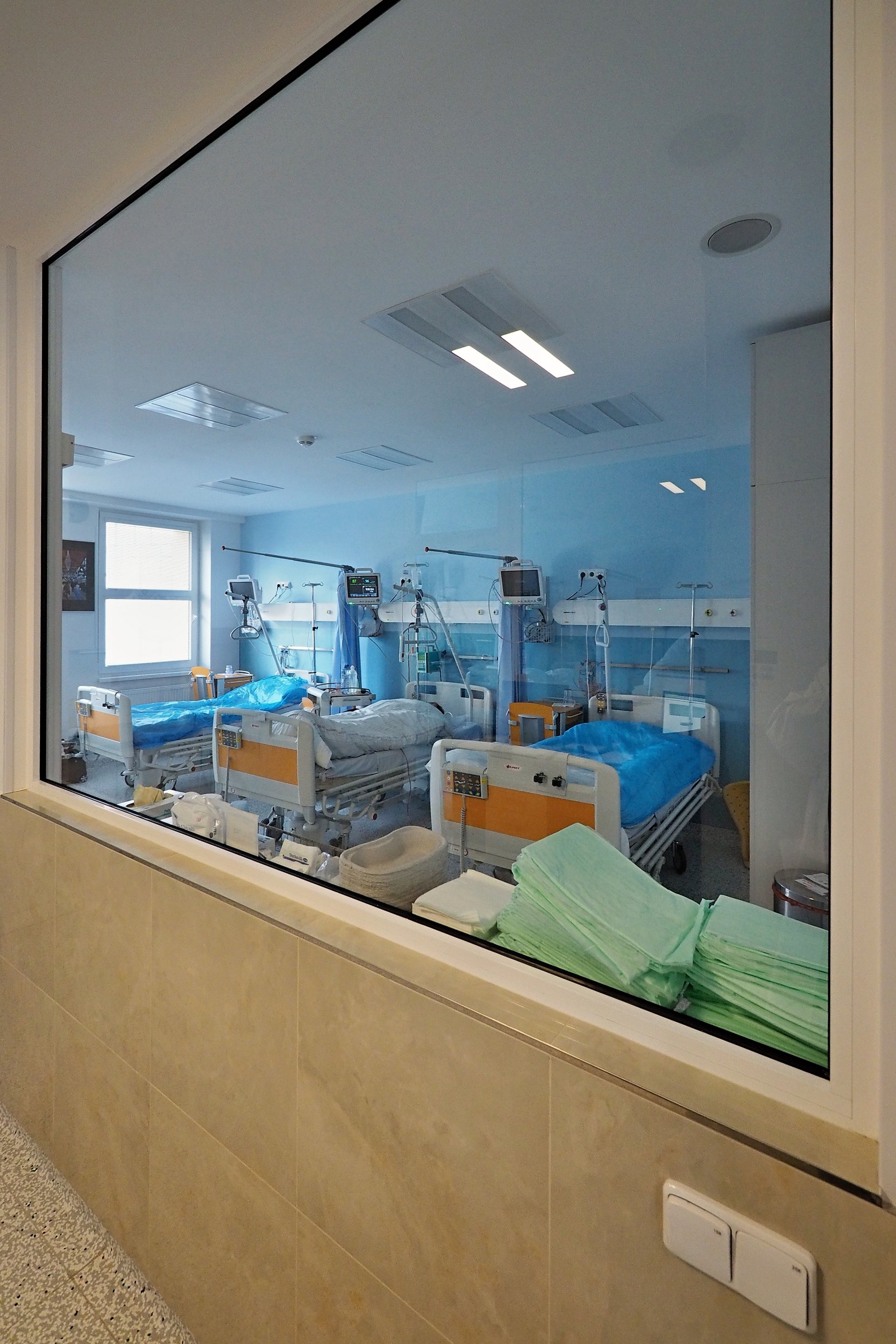
Rehabilitation is possible in the inpatient ward during the hospital stay. Each of our patients undergoes rehabilitation while they are in our inpatient ward. We have our own rehabilitation ward and 2 times a day our patients exercise. After discharge, the option is to continue inpatient rehabilitation or attend outpatient rehabilitation from home. We used to discharge all patients home, the rehab ward did not exist and patients made it. In the early days of its existence, the Hořovice Orthopaedics Hospital took the need for follow-up care as a priority and therefore a symbiosis with the Rehabilitation Hospital Beroun was established. Now, when a patient is booked for surgery, we set the exact date of the operation and the exact date of discharge. At the same time, we give the patient the contact details of our rehabilitation hospital in Beroun to arrange a room there at their discretion. If the patient does not arrange the rehabilitation, it is not in our power to resolve the matter after the operation other than by discharging the patient home after 7 days. The waiting time for surgery in our hospital is 6 months and for rehabilitation is about 3 months. Therefore, we notify all patients about the matter and set a precise time schedule for them to arrange everything.
What are the risks of orthopaedic surgery?
Every operation has its risks. In the language of big numbers, we have a chance of nerve damage in a per mille, we also have infectious complications below 0.5%, and luxation at the level of a tenth of a per mille. So you could say we're among the top. But in the language of small numbers, it could be you as a patient that has a complication. Even if you're operated on by the best surgeon in the world, the risk is still there.
You're in the teaching business. How do young medical students compare to your generation?
I don't teach at the faculty level. That belongs to the staff of teaching hospitals. But of course I meet young graduates, perhaps at various conferences and professional seminars. This spring, I participated in the organisation of the Central Bohemian Orthopaedic Symposium in Benešov, which has a national scope. We can say that we were better, more diligent, more patient, but perhaps that would be a reminiscent optimism. It is right that the young are different. Incidentally, it was they who gradually refused to serve overtime and cumulative Friday to Monday duty and it is only through their pressure that the situation has now normalised and compensatory leave has started to be taken. So I am cheering on the young people. I believe they also realise that our generation can enrich them
What led you personally to orthopaedics?
When I decided to go into medicine, I wanted to do paediatric cardiac surgery. Given the difficult situation on the job market, that wish was not very realistic, so I considered another direction. Perhaps I was influenced by the hospital on the edge of town. I realised that I wanted to do trauma and bone surgery.
Is there any wish that hasn't come true in your professional life?
Of course. I think that's where the small paths begin at the end of the road. You just have to keep going somewhere. In orthopaedics today, I'm still dissatisfied with the results. I am personally interested in the organisation of work and optimising hospitalisation. The population is ageing and is therefore in worse shape at the time of hospitalisation. It used to be that only precisely selected people were operated on for joint replacements, slim, elderly, with little requirement for further performance. Today, the population is unfortunately overweight, and we not infrequently operate on people where a special operating room table has to be installed. The patient's BMI exceeds 50, which is monstrous obesity. Then there is the problem of operating on younger people who have high demands on the outcome of the surgery. Therefore, nostop develops new designs of prostheses, new materials that can withstand higher loads. A big problem is revision surgery, where there is already little bone and it is often not possible to resolve the situation satisfactorily. The problems of health care are perhaps not known to the people. In Austria, the number of trauma operations on geriatric patients doubled between 2000 and 2010. This places a strain on the system. My plan is therefore to optimise and speed up everything that can be done so that, with the current hospital capacity and staffing, more patients can be helped in the future without compromising quality and outcome.
Do you have time for any hobbies with your busy schedule? What are they?
My hobby is my family. Since I have very little time outside of work, I have cut back on everything I could. I kept only reading, about 1 hour every day. I haven't had a TV for 14 years, so I've gained a lot of time. I try to devote myself to my children - we go for walks, on my bike, I teach them to ski, because I believe that when I am old, they will devote themselves to me. The social welfare system won't have the capacity to do that when I retire.