Česky
Česky


Personally, I don't plan any more births, because three children are enough for me, but if I could choose now, I would choose only the maternity hospital in Hořovice in the Central Bohemia region. That is where we went with the editor-in-chief of Mamika and a photographer for a reportage. We also chose the Hořovice maternity hospital because it is famous and praised to the skies among mothers (even Prague mothers). Even though Hořovice is not a big city, its maternity hospital U Sluneční brány is one of those worth talking about. It may be the smallest in the Central Bohemia region, but it has the most births (except in Prague). Last year alone, 1,599 babies were born here, including one triplet! The local maternity hospital attracts mothers-to-be with its modern and pleasant facilities and, above all, with its kind staff. It is no wonder that many expectant mothers want to come here, no matter how far they live.
8.00-10.00: Delivery in the operating theatre
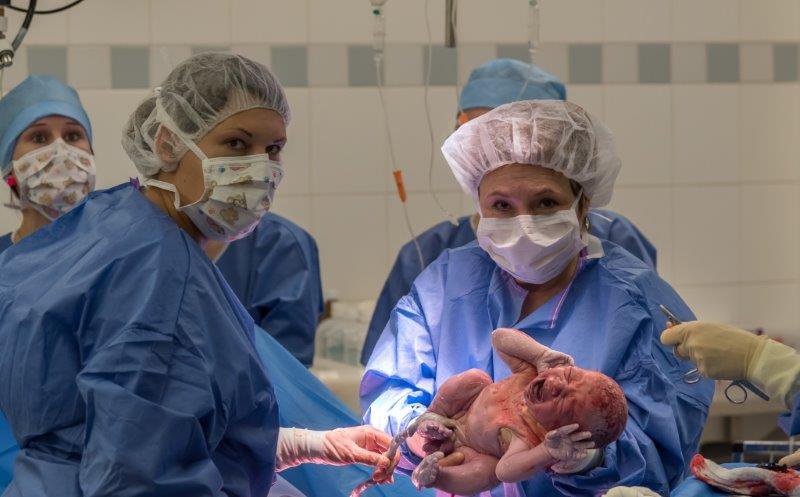
We head to the maternity ward and don't linger too long on the way, because the chief doctor, Věra Pavlů, with whom we will spend almost the whole day, is preparing for a planned caesarean section. The sympathetic doctor greets us and asks if we want to be there. Of course we agree, so we quickly change into our blue surgical scrubs, put our caps on our heads and tie a drape over our mouths. For the sake of intimacy, we stay in the anteroom, where we watch the birth from afar. The operating room is already busy, the pregnant mother is lying on the bed waiting for the operating team. "This is the second time the mother has given birth by caesarean section, because the first delivery was a pelvic delivery and she had a scar on her uterus. A natural birth would not have been suitable, there were reasons why the operation was indicated," explains the chief surgeon Pavlů, and even though she is about to undergo a difficult surgery in a few minutes, she is smiling and at ease. Will it be a boy or a girl? "Well, my mother knows, I knew it too, but I've forgotten. So it will be a surprise for me," she laughs. Then he heads quickly to the operating room. Although we don't see everything, it's clear that a C-section is no walk in the park; it's a bloodletting operation and can be riskier for the mother than a spontaneous birth. At exactly 8.37 a.m., little Petya is born. 3280 grams and 49 centimetres, a healthy and beautiful baby boy screams to the whole room. The neonatologist Hana Tobrmanová, MD, together with a nurse from the neonatology department, are treating the baby and showing him to the mother, who gave birth under spinal analgesia, i.e. she is conscious. The atmosphere of the birth is so strong that tears come to my eyes. They take Petya to the neonatology ward, where he will spend the next two hours warming himself in an incubator. The chief surgeon Pavlu stays in the ward, waiting for the "more difficult" part of the caesarean section. The placenta has to be removed, the uterus and the abdomen stitched up. It doesn't seem like it, but this whole "procedure" takes almost an hour. We are waiting for the headmistress and in the meantime another mother is brought to one of the three delivery rooms. The delivery room doesn't stay empty for long, the mothers change at lightning speed. "About 5-6 babies are born here every day, that's our norm. Today, 3 have been born since this morning, so we will be full by lunchtime," laughs the nurse in the delivery room. At 9.20 a.m., the head doctor arrives. She looks happy but tired. "Now I have to write up the operation report," she says, and we go on to the next tour of the maternity ward - the neonatology ward and the six-week ward. On the way we meet the head nurse of the maternity ward, Mgr. Pavla Fíkarová, who is celebrating her birthday today. "What is the most important thing? A great team, and I have one," she smiles.
10.00 - 11.00: An environment almost like home
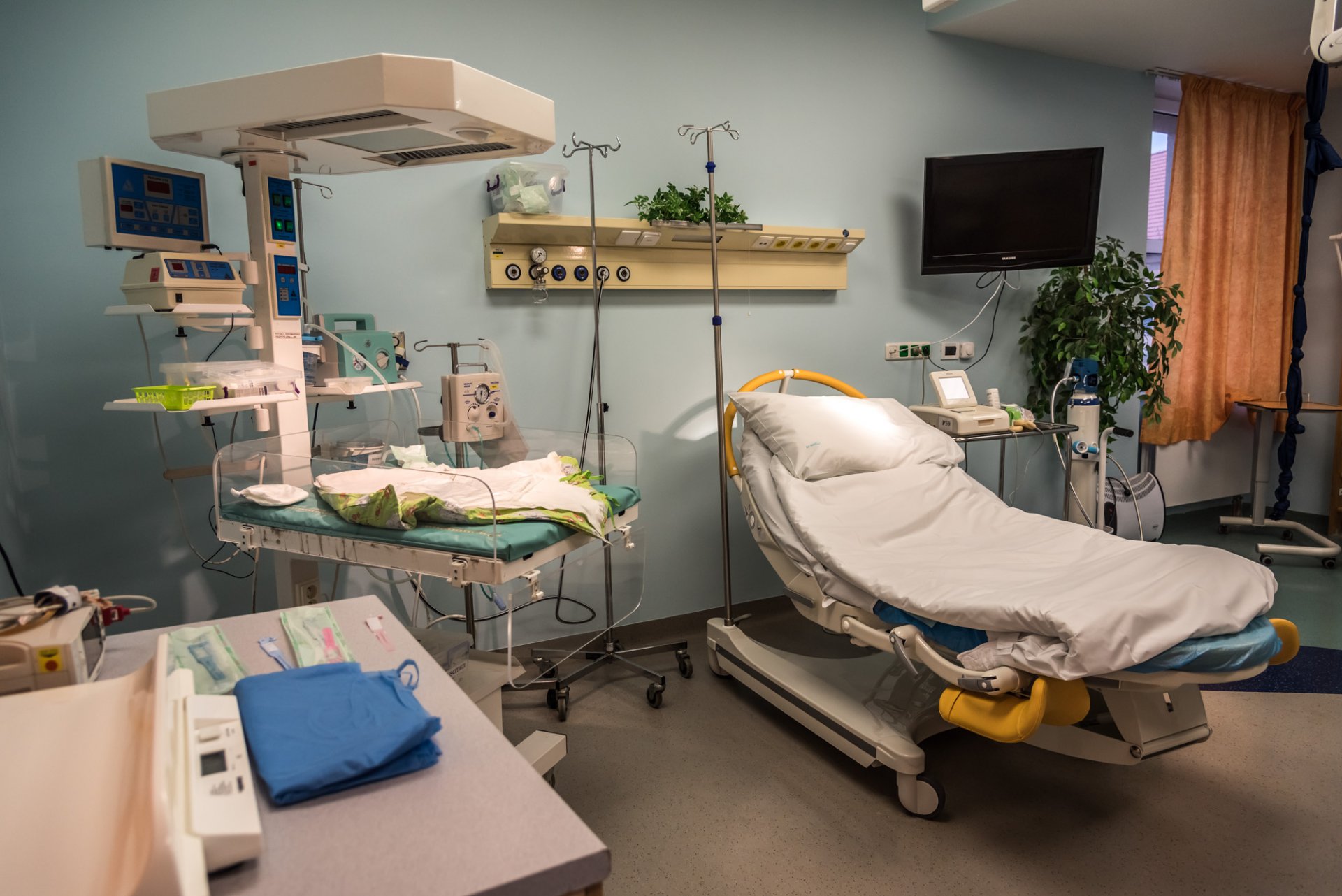
The neonatology ward and the sixth ward are on the same corridor and it looks really beautiful. That's also why we're not surprised to hear that they've won a design award. Everything is modern and, most importantly, welcoming, so new mothers feel at home here. The neonatology ward with intensive care was classified as a Perinatology Intermediate Care Centre in 2014 and can thus boldly compete with the largest and most modern Prague maternity hospitals. Deliveries are possible here from the 32nd week of pregnancy. We walk through the ward and peek into the room where freshly born babies are "warmed" in incubators and warming beds. Neonatologist Hana Tobrmanová, MD, says: "After the birth, the mother takes a shower before she gets herself together, so the baby is in the incubator to warm up. It is connected to a monitor that senses oxygenation and heart action, then it is examined, bathed and warmed up again so that it doesn't get cold, because after birth thermoregulation has to start. When the mother is fit and spry, the baby goes to her room." If the mother has had a caesarean section, like little Pety's mother, the nurses bring the baby to her every three hours and put it to her breast so that the mother can be in contact with the baby. "Everything is very close here, which is an advantage because in some maternity hospitals it is more complicated," says the neonatologist. At 10.20am, Chief Nurse Pavlu runs through to check on the mum, who had a caesarean section that morning. Empathetically and with a smile, she asks her how she feels, if everything is all right. "After the operative birth, the mothers are monitored here in the intermediate rooms, to see if the marrow is okay, if she is bleeding, if she has enough urine, if the uterus is wrapping up, if she is bleeding from the vagina," says the head doctor Pavlu. The baby in the tummy has weak echoes, so it is necessary to examine the mother. "She is only 5 centimetres dilated, so if she should give birth now, then only by caesarean," says the doctor. We go back to the neonatology ward and the neonatal ward, where we look at the rooms. They really look like home. The physiological neonatal unit has a capacity of 24 beds, and here the babies are treated in a rooming-in system with maximum breastfeeding support. "Occasionally there is a mother who doesn't want to breastfeed, but we usually persuade her to try. Most of our nurses have completed courses in lactation counselling and are able to support mothers in the beginning stages of breastfeeding," says David Frejlach, MD, a young doctor who became a father himself last night (his wife gave birth to a baby boy in the local maternity hospital).
11.00-12.00. It never ends
We go back to the reception of the maternity ward, where the chief nurse explains how things work here. "This is where every mother who goes into labour comes. Here we write up the intake paperwork, the doctor examines her, and an initial cardiotocograph is taken. If the finding is advanced, the mum moves to the delivery room, if it's a full on or false alarm, she goes to gynaecology. But there is no problem to move the mother from the delivery room to the gynaecology and vice versa," says Vera Pavlů. The maternity hospital has 3 separate, fully equipped delivery rooms and 1 operating room. Everything is in close proximity. It is usually crowded, and sometimes it is so crowded that it is necessary to improvise. "So we give birth in the reception or the operating theatre, there is nothing to be done," laughs headmistress Pavlu. We ask when the most births take place. "A lot of them are in the summer, especially when there is a queue. As soon as there are weather changes, a storm is coming, for example, we know we'll be busy. But it's not a rule, nature itself sometimes doesn't know where the beginning is, where the trigger of that birth is. Whether it's in the baby, the placenta or the mother's brain. There are many theories, but none of them explain it. We may know all the biomechanisms that lead to birth, but what ultimately triggers it, we don't know," smiles the doctor. The sympathetic chief doctor has been doing this job for almost thirty years and has no regrets. When we ask her if anything has changed in that time, she says: "Mothers have changed, they are more educated, also thanks to the internet. But midwifery is an old field, which is still the same except for the equipment, which has changed for the better, of course." It's after twelve o'clock and Chief Pavlu is getting ready to go home after a long shift. She is looking forward to getting some rest so she can start again the next day. Smiling, professional and calm. That's the most important thing - that the women feel as comfortable as possible.
What else is good to know...
- Childbirth in the Hořovice Maternity Hospital is conducted in an intimate atmosphere in modernly equipped delivery rooms with the possibility of using a birthing tub, ladders, mattresses, bags, birthing stools and a modern reclining bed. Each birthing room includes a separate toilet and shower.
- The presence of the father or other close person at the birth is a matter of course.
- The maternity ward organises for expectant mothers Maternity talks and also a tour of the maternity ward. Part of the preparation for childbirth includes antenatal classes, where expectant mothers are informed about the course of care for the baby from birth until its discharge.
- It is not necessary to register for the birth. Expectant mothers are advised to visit the gynaecological outpatient clinic at the local maternity hospital once before giving birth, preferably in the 36th week of pregnancy, in consultation with the gynaecologist. For more information visit http://www.nemocnice-horovice.cz/oddeleni/porodnice-u-slunecni-brany
- A superior room costs 700 CZK/night, if your partner wants to stay with you in the ward, then you will pay 1500 CZK/night.
Births on request?
MUDr. Věra Pavlů, head of the maternity ward:
- Birth plan. There are bathtubs in the delivery rooms, but we do not allow water birth. But if they want to give birth in a different position, it is possible. We also accommodate those who have a birth plan. Of course, we consult with them and there are really only a minimum of things that don't work here.
- Caesarean section on request. It has to be judged whether the mother really does not want to give birth spontaneously and whether it is a psychological and psychiatric matter, when it is better to give in. As far as a caesarean section is concerned, in the case of a breech delivery, the mother can choose whether she wants to give birth spontaneously (if this is possible and spontaneous birth is not contraindicated) or whether she wants to opt for a caesarean section in the first place.
- Home births: Now that's a chapter in itself. We've had a few of these births brought here too, and it's always worked out well so far. I strongly disagree, on the other hand, everyone should take responsibility for themselves, but the consequences can be dire. We are not omnipotent either, let alone when a woman gives birth at home.