Česky
Česky


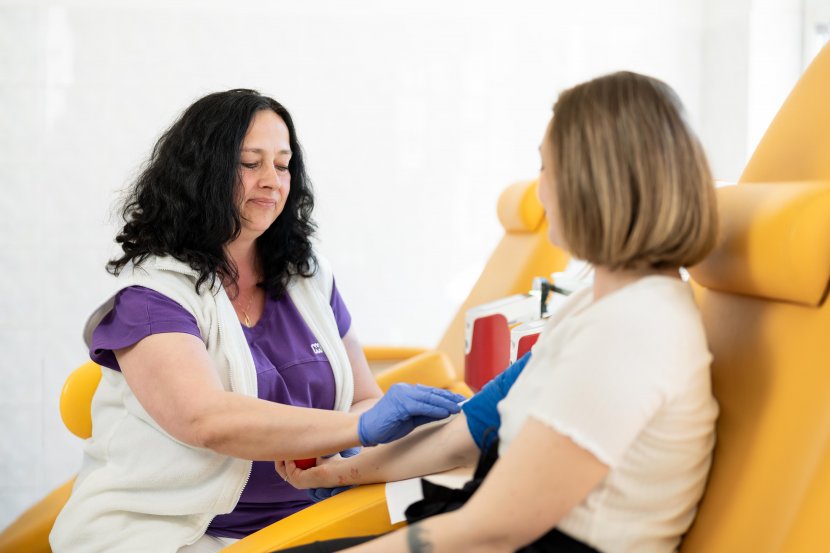
She has plenty of experience to share. She’s been working in healthcare since she was fifteen, when she started out with part-time jobs, and at eighteen she began her first full-time position with the Emergency Medical Service in Prague. “That’s exactly where the TV series *Sanitka* was filmed—and right around the time I was working there,” she recalls with a smile. Over the years, she’s worked in a variety of departments—from inpatient care to outpatient clinics to home care. “I moved around a lot when I was younger, so I changed jobs frequently,” she explains.
She settled in Hořovice when she was looking for more stability. “My third daughter was still very young, so I couldn’t work shifts,” she says. But she has remained in the transfusion department to this day, even though her children have long since grown up.
“It feels like home here. We take care of donors as if they were our own children; we try to make them feel comfortable so they’ll be happy to come back,” she says, describing the workplace atmosphere. According to her, a positive experience is key to attracting new donors. “There really is nothing to be afraid of. Situations where someone feels sick are quite rare. We take the best possible care of everyone,” adds Lenka.
Strict Controls
However, the work of nurses in the transfusion department is far from being limited to the blood draws themselves. A large part of it also involves administrative tasks and, above all, thorough checks.“We’re under strict supervision; we have several types of checks, and we constantly verify the donor’s identity. Sometimes people are surprised by how many times we ask for their name, but every station has its own procedures, and these checks are truly necessary,” explains Lenka. The reason is clear—any mix-up could have serious consequences.
Blood is collected in Hořovice but sent to the Královské Vinohrady University Hospital for further processing. “Any mistake would have repercussions in multiple places. We bear a great responsibility, so we must remain constantly vigilant,” she says.
It was precisely the reliability of the local team that led to another important step—the transfusion department became the gateway to the bone marrow donor registry. “Donors can come to us for their first donation; they don’t have to travel to larger cities like Plzeň or Prague,” he adds.
The latest issue of NÉA magazine features this and many other stories from the daily lives of healthcare facilities within the AKESO holding company.